
5 Barber App Feature Groups Every Shop Needs, With Shop Size Checklist
5 Barber App Feature Groups Every Shop Needs, With Shop Size Checklist

The features that matter most in a barber app fall into five groups: scheduling, client relationship management, payments and tipping, earnings reporting, and client acquisition tools. Every strong barbershop platform builds around these five, then layers on extras like inventory tracking and staff permissions. The sections below break down what to actually look for inside each group, and why some features matter more depending on shop size.
TL;DR:
- A barber app must include provider-specific scheduling with buffer times and conflict prevention to maximize chair utilization and reduce downtime.
- Client relationship tools should focus on quick-access profiles, automated rebooking, and targeted messaging rather than excessive data collection.
- Payment features need to support in-app checkout with tips, split payments, and instant payouts to prevent friction and encourage consistent tipping.
- Revenue tracking should include chair utilization, retail sales, and customizable reports, especially for multi-chair or multi-location shops.
- Growth features such as portfolio galleries, shareable booking links, and review management are essential for attracting new clients beyond just marketplace visibility.
Table of Contents
- What Scheduling Features Should a Barber App Have?
- What Client Relationship Tools Matter Most in Hair Salon App Features?
- How Do Payment and Tipping Features Work in Barber Apps?
- Why Does Earnings and Reporting Data Matter for Barbers?
- What Growth Features Help Barbers Attract New Clients?
- How Does a Branded Platform Like Exclusively Combine These Features?
- What Inventory and Product Sales Features Should Barber Apps Include?
- How Should Barber Apps Handle Staff Scheduling and Commission Tracking?
- What Customization and Branding Options Should You Look For?
- What Marketing Tools Do the Best Barber App Functions Include?
- How Secure Should a Barber App Be With Client Data?
- Which Barber App Features Should You Prioritize by Business Size?
- Why Consider Exclusively for a Branded Booking and App Solution
- Sources
- FAQ
What Scheduling Features Should a Barber App Have?
Scheduling is the backbone of any barber appointment scheduling tool, and the details matter more than the marketing copy suggests. A calendar that just shows open slots isn’t enough. You need control over how those slots get filled.
Look for provider-level schedules that let each barber set individual hours, service durations, and buffer time between cuts. A fade takes 30 minutes; a color and cut combo might need 90. Apps that force one-size-fits-all time blocks create scheduling gaps that cost real chair time.
- 24/7 online booking so clients aren’t stuck calling during business hours
- Auto-confirmations and reminder texts that cut down on no-shows
- Walk-in and waitlist handling for shops that mix appointments with drop-ins
- Premium hour pricing for evening or weekend slots
- Multi-chair conflict prevention so two clients never get booked with the same barber
Pro Tip: Set buffer times of five to ten minutes between appointments, even if it feels like wasted time on the calendar. Barbers who skip buffers end up running 20 minutes behind by 2 p.m., and that frustration shows up in reviews.
These features exist to solve one problem: idle chairs cost money, and manual booking eats hours you could spend cutting hair.
What Client Relationship Tools Matter Most in Hair Salon App Features?
Client memory is the difference between a one-time visit and a five-year regular. The best hair salon app features treat client history as a working file, not a static record.
A solid client profile stores visit history, before-and-after photos, product preferences, and any allergy or skin sensitivity notes. That last part matters more than people assume. A barber who remembers a client reacted to a certain aftershave two visits ago builds trust that no discount code can buy.
- Two-way messaging for quick questions or last-minute reschedules
- Blast messaging for shop-wide announcements like holiday hours
- Automated rebooking prompts sent a few weeks after the last visit
- Loyalty programs tied to visit counts or referral rewards
- Recurring appointment slots for clients who come in every three or four weeks
Pro Tip: Don’t over-collect data. A note like “prefers scissor cut, sensitive scalp” is more useful than a paragraph. The goal is quick recall during a five-minute consultation, not a full client dossier.
Marketing automations tied to booking systems, similar to what ConvertKit’s feature set offers for lead capture, work well when layered onto client messaging. They let you segment lapsed clients and send a targeted nudge instead of a generic blast.
How Do Payment and Tipping Features Work in Barber Apps?
Payment friction loses clients faster than almost anything else. The best barber shop management tools handle checkout in seconds, not minutes.
In-app payments should support Apple Pay, Google Pay, and standard card tokenization so a client can pay without digging for a wallet. Tip handling needs to be built in too, ideally with split-tip options for shops where multiple people touch one service (a cut from one barber, a beard trim from another).
- Deposit collection for high-demand appointments or first-time clients
- Payout frequency choices, whether daily, weekly, or monthly
- Instant payout options for barbers who need same-day cash flow
- Commission-aware splitting so tips and service revenue route correctly
- POS and bookkeeping export for tax season
Platforms built on established processors, like the terms outlined in Exclusively’s Square payment integration, give barbers a clearer picture of processing fees and payout timing before they commit.
Why Does Earnings and Reporting Data Matter for Barbers?
You can’t fix a slow Tuesday if you don’t know it’s slow. Reporting features turn a booking app into an actual business tool.
The essentials are revenue by period, appointment trend tracking, retail product sales, and a clean export button for your accountant. Chair utilization metrics deserve special attention. If one chair sits empty three afternoons a week, that’s a pricing problem or a scheduling problem, and you won’t spot it without the data.
- Daily and monthly revenue breakdowns
- Hours-booked percentage per barber or per chair
- Retail sales tracking separate from service revenue
- Commission calculations for multi-barber payroll
- CSV or PDF export for tax prep
Most single-location shops don’t need enterprise business intelligence. Save the deeper analytics for shops running multiple barbers on commission splits, where modular reporting and commission tracking becomes worth the added complexity.
What Growth Features Help Barbers Attract New Clients?
Getting new clients through the door depends on how visible and shareable your work is. Growth features fall into a few clear categories.
-
Portfolio galleries. High-quality before-and-after photos act as social proof, and clients scroll through a barber’s gallery the same way they’d check a restaurant’s Instagram before booking a table.
-
Discovery placement. In-app marketplaces get you found by strangers searching nearby, but they also mean competing on the same screen as every other barber in the app. A personal booking link sidesteps that entirely.
-
Ratings and review management. A steady flow of reviews, especially ones a barber can respond to, builds trust faster than any ad spend.
-
Shareable booking links. A link you can drop in an Instagram bio turns social media followers directly into booked appointments.
-
Targeted promotions. Service bundles and win-back messages for clients who haven’t booked in 60 or 90 days keep the client base from quietly shrinking.
Branded app and website combinations tend to outperform marketplace-only setups here. Partner data from a branded platform success story shows that pairing a strong portfolio with a clear booking link and consistent branding increases direct bookings without relying on marketplace algorithms.
How Does a Branded Platform Like Exclusively Combine These Features?
A branded platform ties the five feature groups into one system instead of five disconnected tools. Exclusively’s setup pairs a custom barbershop website with booking, provider-level pricing, and a branded mobile app that carries the shop’s own name, not a marketplace logo.
That matters because a branded presence reduces dependency on marketplace discovery and gives the owner control over pricing, availability, and client experience end to end, a point echoed in how Exclusively frames its own platform.
The practical upside: a client who books through your own app associates the experience with your brand, not a third-party directory they’ll use to compare you against five competitors next week.
What Inventory and Product Sales Features Should Barber Apps Include?
Product sales quietly add up. A shop selling pomade, beard oil, and shampoo needs stock tracking built into the same system that handles bookings, not a separate spreadsheet nobody updates.
Inventory features worth checking for include low-stock alerts, per-product sales tracking, and the ability to ring up retail items at checkout alongside the service charge. That single-checkout flow matters more than it sounds. A client paying for a haircut is far more likely to grab a bottle of beard oil if it’s a one-tap add at the register than if they have to complete a separate transaction.

Product sales integration also feeds back into reporting. Retail revenue tracked separately from service revenue tells you which products actually move and which ones are gathering dust on a shelf. Some platforms tie reorder alerts to sales velocity, so a barber gets a nudge before running out of a popular pomade rather than after a client walks out empty handed.
For multi-chair shops, inventory tracking also needs to account for shared stock versus barber-specific product lines, especially in suites where individual barbers stock and sell their own retail brands. An app that treats all product sales as shop-wide revenue creates commission disputes fast. Look for systems that let you tag inventory by barber or by station, so retail commissions get calculated the same way service commissions do.
How Should Barber Apps Handle Staff Scheduling and Commission Tracking?
Multi-chair shops live or die by how cleanly they manage staff. Employee and resource management features need to cover three things: individual schedules, commission math, and who gets to see what.
Staff scheduling should let each barber manage their own hours within limits the owner sets, rather than forcing every schedule change through the front desk. Commission tracking needs to handle different structures, since some shops pay flat commission splits while others use tiered rates that increase once a barber hits a revenue threshold. An app that only supports one commission model will frustrate any shop trying to run performance incentives.

Role permissions matter just as much, especially as a shop grows past two or three barbers. An owner needs full visibility into every chair’s revenue and schedule. A barber typically needs access to their own calendar, their own client notes, and their own earnings, not the whole shop’s financials. Booth renters need something in between: control over their own bookings and pricing without giving them the keys to shop-wide settings.
Getting these permissions wrong causes real friction. Barbers who feel over-monitored complain; owners who can’t see chair-level performance can’t make good staffing decisions. The apps that handle this well let owners assign roles (owner, manager, barber, booth renter) with permission templates instead of manually configuring access for each person.
What Customization and Branding Options Should You Look For?
A generic-looking booking page undercuts the work you put into building a shop’s reputation. Customization features determine whether clients feel like they’re booking with your brand or borrowing someone else’s app.
At minimum, look for a customizable app interface that lets you set your shop’s colors, logo, and imagery instead of a stock template every other shop on the platform uses. Service menu customization matters just as much. Shops need to name services their own way (a “signature fade” instead of a generic “haircut” line item), set their own pricing per service, and group add-ons like beard trims or hot towel treatments however makes sense for their workflow.
The deeper value shows up in consistency across touchpoints. A client who books through your website, then gets a reminder text, then opens your mobile app should see the same logo, colors, and tone every time. Platforms that split branding across a generic booking widget and a separate marketplace listing create a disjointed experience that undercuts the professional image a shop worked to build.
For barbers building a personal brand separate from the shop, granular control matters too. A booth renter or independent barber using a platform with provider-level branding controls can maintain their own visual identity even inside a multi-barber shop’s broader system, which keeps individual reputation-building intact without splintering the shop’s overall presence.
What Marketing Tools Do the Best Barber App Functions Include?
Marketing tools inside a barber app turn a booking system into a client-retention engine. The most useful ones are discount codes, push notifications, and email campaigns, each solving a different problem.
Discount codes work best for acquisition. A “20% off first visit” code shared on social media or through a referral gives new clients a reason to try a shop instead of a competitor down the street. Push notifications work better for retention. A quick alert about a last-minute opening or a slow-Tuesday discount fills chairs that would otherwise sit empty.
Email campaigns cover the middle ground; longer-form messages about new services, seasonal promotions, or a shop’s story. Tools built for lead capture and segmented campaigns, like the automation options in ConvertKit’s feature set, pair naturally with booking data since you can trigger a specific email sequence based on how long it’s been since a client’s last visit.
The mistake most shops make is treating every marketing tool the same way. The same offer, sent only to clients who haven’t booked in 60 days, feels like a thoughtful nudge. Apps that let you segment by visit recency, service type, or spend level make that kind of targeting possible without needing a separate marketing platform.
How Secure Should a Barber App Be With Client Data?
Client data in a barber app includes payment information, contact details, and sometimes health-adjacent notes like skin sensitivities. That combination makes security features non-negotiable, not a nice-to-have buried in the settings menu.
Look for apps that use tokenized card storage instead of holding raw card numbers, meaning your system never actually stores the sensitive card data itself. Two-factor authentication for staff logins prevents a lost or stolen phone from becoming a data breach. Role-based access, covered earlier in the staff management context, also functions as a security feature since it limits how many people can see sensitive client information.
Data encryption in transit and at rest should be standard, not a premium add-on. If an app’s pricing page lists “enhanced security” as a paid upgrade, treat that as a red flag rather than a feature. Payment processing built on established infrastructure, such as the standards outlined in Stripe’s payment processing terms, typically means the heavy compliance lifting (PCI standards, fraud monitoring) is handled by the processor rather than left to the barbershop’s own systems.
Client trust depends on this working invisibly. Nobody praises an app for good security, but a single breach involving stored card numbers or leaked contact lists can end a shop’s reputation faster than any bad review.
Which Barber App Features Should You Prioritize by Business Size?
A solo barber should prioritize simple booking, client profiles, in-app payments, and a shareable social booking link. A busy multi-chair shop needs multi-provider scheduling, commission rules, tip splitting, and chair utilization reports. Multi-location owners should focus on centralized admin, role-based access, cross-location analytics, and marketing automation that runs consistently across every site.
— Service
Why Consider Exclusively for a Branded Booking and App Solution
Most barber apps hand you a listing inside someone else’s marketplace. Exclusively hands you the whole storefront: a website, booking system, and native mobile app that carry your shop’s name and nobody else’s.
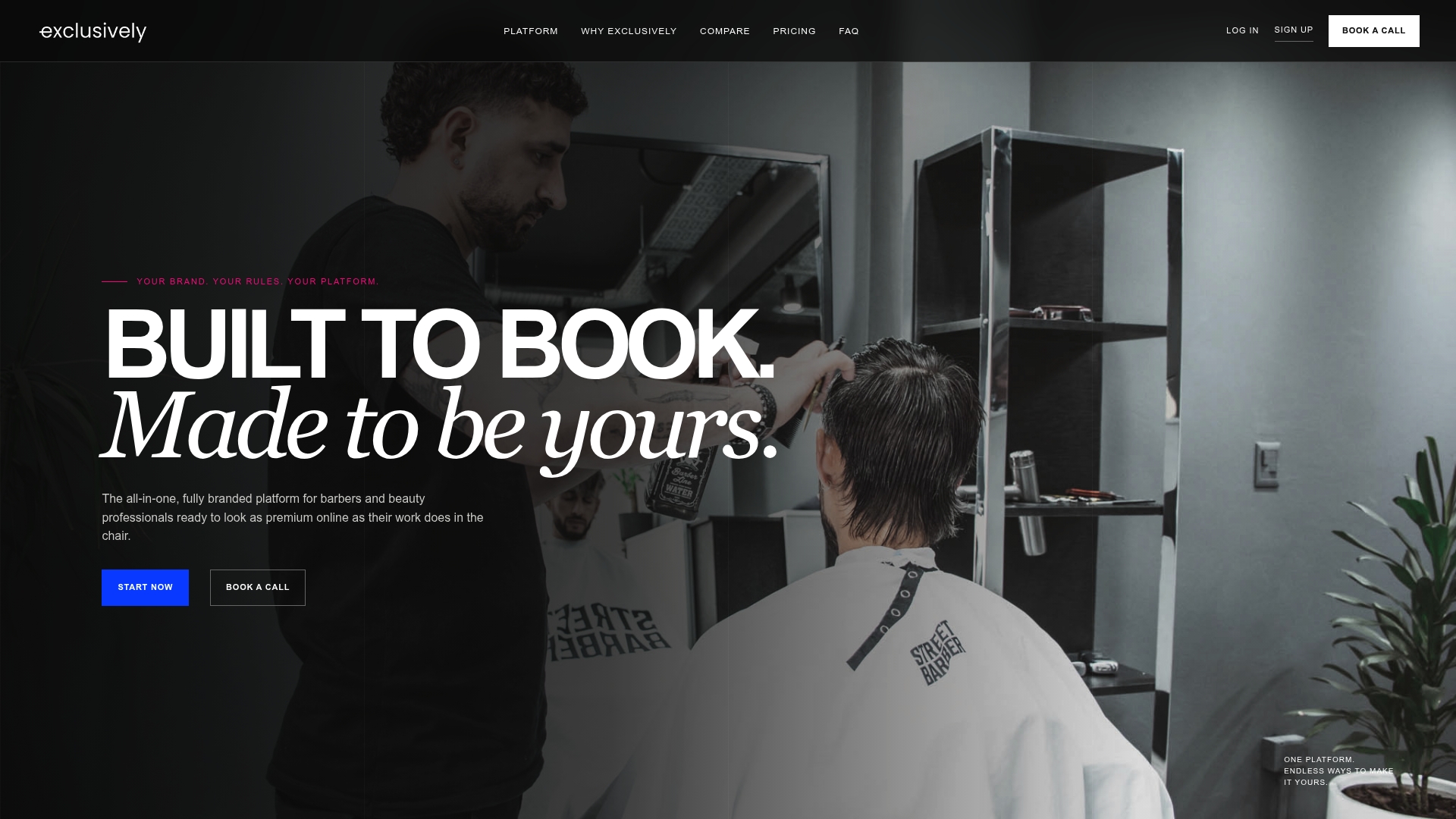
The platform gives each barber provider-level control over pricing, availability, and service menus, while the shop owner keeps central control over branding across every touchpoint. Payments run through integrated Square processing, so checkout and payout tracking live in the same system as your bookings, not a separate app you have to reconcile manually.
Plans scale with what a shop actually needs. The Business Website plan starts at $49 per month for a branded site alone, Website + Booking runs $199 per month, and Website + Booking + Apps, which includes the native iOS and Android app, runs $299 per month. Additional locations add $49 per month each. Check the full pricing breakdown or book a call to see which tier fits your shop’s size.
Sources
FAQ
What Is the Best Barber App?
The best barber app depends on shop size and goals: solo barbers often want simple booking and payments, while multi-chair shops need commission tracking and staff permissions. Barber apps typically group core features into scheduling, client management, payments, reporting, and discovery, so the best choice covers all five without forcing you into tools you won’t use. Branded platforms like Exclusively suit owners who want full control over pricing and client experience instead of a shared marketplace listing.
Can Barbers Block Clients on Booking Apps?
Most booking apps, including marketplace platforms, let barbers block or restrict specific clients from booking again, usually through a client management or blocklist setting. This is typically used for repeat no-shows or disrespectful behavior rather than routine scheduling conflicts. Check your specific app’s client management settings, since the exact steps vary by platform.
How Much Should You Tip a $25 Barber?
Some clients tip more for exceptional service or during holidays, but 15% to 20% remains the standard baseline most shops see.
How Much Does GoodBarber Cost?
GoodBarber’s pricing varies by plan, and certain extensions and native app publishing features can raise the baseline cost beyond the entry tier. Exact current pricing is best confirmed directly on GoodBarber’s own site, since plan structures change. For barbershop-specific branded platforms, Exclusively’s pricing starts at $49 per month for a branded website alone, scaling up to $299 per month for website, booking, and native apps combined.