
Turn Views Into Bookings With 3 Photo Angles for Barber Portfolios
Turn Views Into Bookings With 3 Photo Angles for Barber Portfolios

A professional barber portfolio is a tightly curated set of 10 to 15 high-resolution before-and-after and detail shots published on a dedicated website and your Instagram feed. Before-and-after posts get 2 to 3 times more engagement than standard posts, and 78% of potential clients check Instagram before booking, so your portfolio is doing real selling work. Pick your 10 best shots right now and get them live.
TL;DR:
- Your portfolio should feature 10 to 15 high-quality images that showcase technical skill, variety, and range across hair textures and client ages.
- Leading with your strongest transformation shot captures attention immediately, while grouping similar services enhances viewer understanding of your expertise.
- Consistent background, lighting, and branding across all images establish trust and professionalism, especially when expanding to your website.
- Keep your gallery up to date by quarterly editing to showcase current skills, removing outdated or lower-quality shots and ensuring client consent is documented.
- Using your own website with integrated booking links increases conversion, reduces reliance on social algorithms, and projects a longer-lasting, professional business presence.
Table of Contents
- Portfolio examples: essential image types and gallery layouts you can copy
- Photo checklist: the three-angle rule, framing, and camera basics
- How to curate and sequence your gallery so it sells
- Where to publish: Instagram vs website vs print
- Quick shooting setup and low-cost lighting hacks you can do in-shop
- Before-and-after storytelling and handling client permissions
- Digital portfolio usability and mobile optimization
- Stylistic diversity and showcasing different haircut types
- Branding consistency across portfolio
- Target audience identification and tailoring portfolio content accordingly
- Image release/consent and periodic audit
- Practitioner perspective: how a curated portfolio changes the type of clients you attract
- How a branded website with booking turns your portfolio into bookings
- FAQ
- Sources
Portfolio examples: essential image types and gallery layouts you can copy
Every strong barber portfolio draws from the same small set of image types, repeated with variety. You need before-and-after pairs, a straight profile shot, a 45-degree angle that shows silhouette and shape, a macro-detail shot of the blend or line work, a back/taper view, and at least one beard transition if you offer grooming.
Rather than guessing at layout, copy one of these three proven structures:
- The 10-image editorial gallery: five before-and-afters, two profile shots, two detail macros, one wide shop shot for context.
- The 12-image balanced gallery: adds a beard transition and a back/taper shot to the editorial set for barbers with a broader service menu.
- The 15-image specialty show: built for barbers targeting a niche (fades, textured hair, kids’ cuts) with three extra shots proving range within that specialty.
Sequencing matters as much as selection. Lead with your strongest hero after-shot, since that is what stops the scroll. Group remaining images by specialty rather than chronology so a viewer scanning quickly sees range, not repetition.
- Lead with your single best transformation shot.
- Cluster similar services together rather than mixing fades, beards, and kids’ cuts at random.
- Make sure no two consecutive images look like the same haircut from a different angle.
Photo checklist: the three-angle rule, framing, and camera basics
Technical hygiene and lighting materially affect how skilled your work looks and what clients will pay for it, according to one professional blueprint for building a barber portfolio. Before you shoot, run through this checklist:
- Profile shot: straight-on side view that shows fade compression and line placement clearly.
- 45-degree shot: captures the overall silhouette and how the cut sits on the head.
- Macro-detail shot: tight on the blend, the part, or the edge work where your technical skill actually shows.
- File format: shoot high-resolution JPEG or HEIC, or raw if your camera supports it, and keep the originals in a dated folder.
- Background: use one consistent, neutral background across every shoot so the gallery reads as a cohesive body of work.
- Focus: lock focus manually on the blend itself, never the background, and skip portrait mode, since its artificial blur can soften the exact detail you are trying to prove.
Lighting makes or breaks all of it. Diffuse natural window light or a soft LED panel works best. Avoid backlighting, which washes out fade contrast and hides the work you did.
Pro Tip: Shoot the macro-detail shot first, while the line work is freshest, before any client movement softens it.
How to curate and sequence your gallery so it sells
Trade educators recommend keeping your portfolio to 10 to 15 elite images, with a quarterly audit to retire older or weaker shots. A smaller, sharper gallery reads as confidence. A large, inconsistent one reads as filler.
Use these criteria when deciding what stays:
- Technical difficulty: does this shot prove a skill most barbers cannot execute cleanly?
- Texture and age variety: do your images span different hair types, textures, and client ages, not just one look repeated?
- Finish quality: is the edge work, blend, and line consistent with your current skill level, not an older style you have since outgrown?
- Authenticity: the same guidance warns that heavy filters and aggressive AI retouching reduce trust, so keep images honest and high-contrast rather than over-edited.
Captions carry weight too. Pair each image with the service name, one short technique note (for example, “skin fade with a hard part”), and a one-line call to action linking straight to your booking page. A photo without a path to booking is just decoration.
Where to publish: Instagram vs website vs print
Each channel plays a different role, and the strongest barbers use more than one.
- Instagram wins on discovery and social proof. Use Highlights to organize categories (fades, beards, kids) and reels to show your process and shop energy.
- A dedicated website functions less like a storefront and more like a permanent archive. One professional blueprint for 2026 frames social media as the storefront and a personal website as the boardroom: a curated gallery on your own domain, with booking integrated directly, signals permanence that a feed cannot.
- Reels and short-form video reduce friction for new clients by showing them what the shop actually feels like before they ever walk in.
- Print lookbooks still earn their place for high-end in-chair consultations or when applying for a chair at a new shop, where a tactile, curated set of prints feels more deliberate than a phone screen.
Quick shooting setup and low-cost lighting hacks you can do in-shop
You do not need a studio to shoot portfolio-ready images. A consistent setup matters more than expensive gear.
- Pick one wall or backdrop in your shop and always shoot against it, so your gallery looks like one coherent body of work rather than a scrapbook.
- Place a diffused LED panel or ring light at a 45-degree angle to the chair, never directly overhead, to avoid harsh shadows under the brow and jaw.
- Lock your exposure and focus manually before the client sits still for the shot, and skip portrait mode, which can blur exactly the edge detail you want sharp.
- Brace your phone against a tripod or a stable surface rather than shooting handheld, especially for the macro-detail shot.
- Use a light, slightly water-resistant finishing product before the final shot so sweat or humidity does not dull the blend contrast mid-shoot.
Pro Tip: Shoot your after photos within the first 60 seconds of the final reveal, before natural hair movement softens the line work.
Before-and-after storytelling and handling client permissions
The strongest before-and-after posts follow a simple structure: the before shot, a short note on the problem you solved (overgrown, uneven, inconsistent fade), then the after shot with three focus points visible: hairline, crown, and beard transition if relevant.
Before you post any client photo, get written consent. A short release form covering the client’s name, date, and explicit permission to use the image for marketing is enough, and it should live in a dedicated folder, digital or physical, that you can produce if a client later asks you to take a post down.
- Before shot, brief problem note, after shot: that order, every time.
- Caption template: service name, one technique note, and a direct link to book.
- Store every signed release in one place, tied to the client’s name and shoot date.
Digital portfolio usability and mobile optimization
Most people browsing your portfolio will do it on a phone, often while deciding whether to book in the next few minutes. If your gallery loads slowly, crops images awkwardly, or buries the booking button three taps deep, you lose that decision window.
A few usability basics matter more than any design trend. Images should load fast even on a weak connection, which means compressing files for web without stripping so much detail that the fade lines blur. Galleries should scroll in one direction, not force a pinch-and-zoom to see a full haircut. Example shop pages, like Mike Blendz Barbershop’s portfolio, organize their galleries as clickable collections that link straight from an image to the matching service page, which keeps a mobile visitor moving toward booking rather than bouncing back to a menu.

The booking button itself needs to be visible without scrolling past the first image. If a visitor has to hunt for it, you have already lost some percentage of that traffic to a competitor’s feed. Test your own site on your own phone, in regular daylight, the way a prospective client actually would: squint at it, try to book in under 30 seconds, and fix whatever gets in the way.
Single-page galleries, where every image sits adjacent to a visible booking link, tend to convert well precisely because they remove the extra step, a pattern visible on small shop sites like Jakub’s Cuts in Belfast.
Stylistic diversity and showcasing different haircut types
A portfolio full of the same fade on the same hair type tells a client you can do one thing well. A portfolio that spans textures, lengths, and client ages tells them you can solve their specific problem, whatever it is.
Aim to represent your actual service menu, not just your favorite cuts. If you do fades, beard work, kids’ cuts, and textured hair, each category deserves at least one strong example. Skipping a category because you have fewer photos of it just means you need to shoot more of it, not that you should hide the gap.
Diversity also protects you from a narrow audience. A client with curly or coily hair scrolling a gallery of only straight-hair fades has no evidence you can handle their texture, and will likely keep scrolling to someone else’s page. The same applies to age: a gallery of only twenty-something clients can quietly signal to an older client that this is not their shop.
Organize this diversity deliberately rather than hoping it happens naturally. Group by specialty within the gallery, or use Instagram Highlights to create separate categories (fades, beards, kids, textured hair) so a visitor looking for their specific need finds proof fast instead of scrolling past ten shots that do not apply to them.

Branding consistency across portfolio
Your portfolio is often a client’s first impression of your business, not just your scissors. Inconsistent backgrounds, mismatched filters, random fonts on captions, or a profile photo that does not match your website header all chip away at the sense that this is a real, established operation.
Pick one visual signature and repeat it everywhere: the same background or chair setup in every shot, the same caption format, the same logo mark or color if you use one on your website or social bio. This is less about design polish and more about trust. A consistent look across Instagram, your website, and any printed material tells a prospective client that the same care you put into a haircut, you put into how you present yourself.
This matters more once you are running a website alongside social media. A gallery that looks sharp and cohesive on your own domain, matching the same tone and visual style as your Instagram, reinforces that you are the same professional in both places, not a casual hobbyist on one platform and a business on the other.
Target audience identification and tailoring portfolio content accordingly
Before you decide what goes in your next 10 photos, decide who you are trying to reach. A barber building a client base of young professionals wanting sharp, low-maintenance fades needs a different gallery than one targeting fathers bringing in kids for weekend cuts, or one building a niche around curly and textured hair.
Look at your current best clients, the ones who book regularly and refer others, and ask what they have in common: age range, hair type, the specific service they request most. Your portfolio should lean into proving you excel at exactly that, rather than trying to show a little bit of everything to everyone.
This does not mean narrowing your actual skill set, just your presentation. If your strongest, most consistent bookings come from classic fades on short hair, lead your gallery with that strength, then use remaining slots to show range. A portfolio that speaks clearly to one audience converts better than one trying to please everyone equally.
Image release/consent and periodic audit
Two habits separate a portfolio that holds up over time from one that quietly becomes a liability: written consent and regular pruning.
Every client photo you post needs a signed release, even informal, confirming they agree to the image being used for marketing. Keep these on file, organized by client name and date, so you can produce one quickly if a client ever asks about how their photo is being used or requests it be taken down.
Trade educators also recommend a quarterly audit of your entire gallery: pull any shot that no longer reflects your current skill level, replace it with more recent, higher-difficulty work, and double-check that every image still has a valid release on file. A portfolio you built two years ago is not necessarily the portfolio that represents you today.
Practitioner perspective: how a curated portfolio changes the type of clients you attract
Curated, technically sharp imagery signals mastery and gives you room to charge accordingly. Likes and comments feel good, but they are not revenue: a booking link next to every image is what actually converts attention into a filled chair. Owning your gallery on your own website, rather than renting space on someone else’s feed, protects you from algorithm changes and quietly tells every visitor that your business is built to last.
— Service
How a branded website with booking turns your portfolio into bookings
Hosting your best work on Instagram alone means an algorithm decides who sees it, and a booking click still routes through a bio link that was never built for conversion. A custom barbershop website solves the actual job: a high-resolution gallery that lives on your own domain, with booking built directly into every image, so a visitor never has to leave the page to grab a slot.
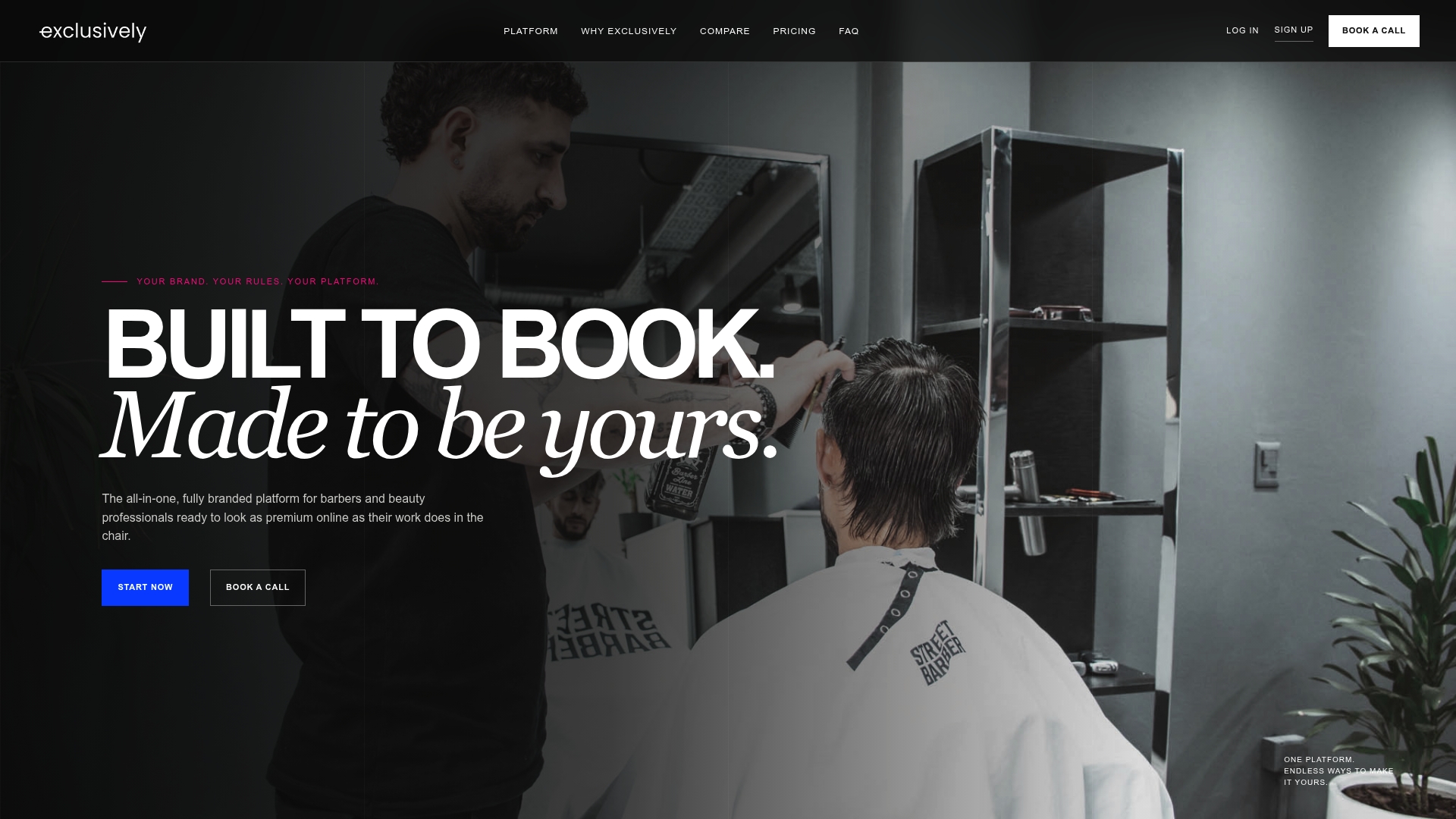
We offer a platform that includes a branded site, a native mobile app, and provider-level control over pricing and availability, all under your own name rather than a shared marketplace profile. You keep the brand, we handle the infrastructure. Plans start at $49 a month for a Business Website, with booking and app tiers available as your portfolio and client base grow. If you want to see what a gallery like this looks like on your own domain, book a call and we will walk you through it.
FAQ
Are barbers struggling in 2026?
Demand for skilled barbers remains steady in most markets, though competition for visibility online has increased as more barbers build social portfolios. A strong, well-maintained portfolio with integrated booking is one of the clearest ways to stand out in a crowded feed.
Can a barber make $100,000 a year?
Income varies widely by location, clientele, specialty, and business model, so there is no single universal figure. Barbers who combine strong technical skill with a professional portfolio and consistent booking flow tend to command higher prices and fuller schedules, which directly affects annual earnings.
What is a good portfolio for a hair stylist?
A good portfolio is a tightly curated set of 10 to 15 images showing clear before-and-afters, varied angles, and a range of client types and textures, published on both social media and a dedicated website. Trade educators specifically recommend 10 to 15 elite images with a quarterly review rather than a large, unfiltered gallery.
How to attract clients as a barber?
Publishing a curated before-and-after portfolio with booking links attached is one of the most direct ways to attract new clients, since Salon SEO Services help make your portfolio more discoverable where potential clients search before booking. Pairing that portfolio with a professional website, consistent branding, and visible booking access removes friction between someone finding your work and actually scheduling an appointment.
Sources
- Before-and-after photos that actually get you clients — Medium
- Creating a professional barber portfolio to showcase your work — TheBarberSchool
- How to build a barber portfolio: the professional blueprint for 2026 — BarberNation
- Portfolio | Mike Blendz Barbershop