
Barber SMS Marketing: Texts That Fill Your Chair
Barber SMS Marketing: Texts That Fill Your Chair

Barber SMS marketing works when every text does one job and ends in one tap: a booking link on a page that looks like your shop. Get permission first, send few messages, keep them personal, and point each one to your own branded booking page, so the client who replies is already inside your brand when they pick a time.
This guide covers what to send, when, how often, what the US rules require, and how to see whether the texts are filling your calendar. It is written for barbers, suite owners, independent beauty pros and educators who want clients to come back without relying on a social feed.
TL;DR
- Collect permission at the chair, in writing, and keep a record. A phone number alone is not consent to send marketing.
- Start with texts that carry the least risk and the most return: confirmations, day-before reminders, rebooking nudges and a quiet win-back text for lapsed clients.
- Send marketing texts between 8 a.m. and 9 p.m. in the client’s time zone, and keep promotions to one or two a month.
- Every text should end in one link to a page that matches your brand and lets the client book in seconds.
- Track bookings by text, not just replies. Compare rebooking rates before and after you start.
Table of Contents
- Why texting suits a barbershop
- Get permission before you send anything
- Timing and cadence
- The six texts worth setting up
- Make every text feel like you
- Where the link should land
- Measure what the texts actually do
- What to look for in a texting setup
- Building the page your texts point to
- A 30-day plan to start
- FAQ
- Sources
Why texting suits a barbershop
A haircut is a repeat purchase on a predictable cycle. Most clients do not forget you; they forget to book. A text arrives where the client already is, and the National Barber Association recommends using SMS to promote in-shop specials and prompt current clients to book their next appointment, ideally with personalized messages tied to a loyalty program.
That framing matters. Barber texting is not mass advertising. It is a short, personal nudge from the person who cuts the client’s hair, sent at the moment the client is due.
Get permission before you send anything
The most common mistake is building a list from the phone numbers in your booking history and blasting it. In the US, marketing texts fall under the Telephone Consumer Protection Act (TCPA), the federal law that governs automated calls and texts. Compliance guides describe the requirement as prior express written consent, clear disclosure before the client agrees, and a simple way to stop messages, such as replying STOP, honored promptly.
In a shop, that turns into a short routine:
- Ask at the chair. The client has just seen the cut and is happy. That is the moment to ask whether they want rebooking reminders and occasional offers by text.
- Say what they will get. Tell them roughly how often you will text and what about. Never send more than you promised.
- Capture it in writing. A checkbox on your booking form, a signature on a tablet or a text-to-join keyword all work. Store the date and wording with the number.
- Honor STOP at once. Add the number to a do-not-text list and never move it back.
- Separate service from marketing. Appointment confirmations and reminders are one thing; offers and rebooking nudges are marketing. Keep promotions out of reminders.
Small detail, big payoff: the client who opted in at the chair expects your text, so it feels like service, not spam.
Rules differ outside the US. If you serve clients in other countries, check the local regime before you text them; the UK, for example, requires prior consent or a demonstrable legitimate-interest basis for marketing, and the ASA’s CAP Code says SMS marketing must identify the sender and give a valid opt-out route. This article describes US practice. For a specific legal question about your shop, ask a lawyer who handles marketing compliance.
Timing and cadence
Federal rules set the outer limit for marketing texts at 8 a.m. to 9 p.m. in the recipient’s time zone. Some states are tighter: Florida and Oklahoma end the evening window earlier, and Texas starts later and restricts Sundays. If you have clients with out-of-state numbers, or you run an educator program with students across the country, send inside the narrowest window.
How often? Industry guides usually land on a small number. A conservative starting point is one to two promotional texts a month, and a firm ceiling of three or four. Appointment reminders do not count toward that cap, because the client asked for them by booking.
A simple weekly rhythm for a one-chair or small shop:
| Text | When | Counts as marketing? |
|---|---|---|
| Booking confirmation | Immediately after booking | No |
| Reminder | The day before, plus a short one a few hours ahead | No |
| Thank-you or review request | Same day or next morning | Treat as marketing if it contains an offer |
| Rebooking nudge | A few days before the client’s usual cycle ends | Yes |
| Win-back | After a long gap, such as 60 to 90 days | Yes |
| Promotion | One or two a month | Yes |
The six texts worth setting up
1. Confirmation with your policy
Send it right away. Include the date, time, service, barber, address and your cancellation policy in one line. It cuts confusion later and gives you something to point to.
Hi Marcus, you’re booked for a skin fade with Dre on Thursday at 4:30 p.m. Need to change it? Use your booking link by noon Wednesday. Reply STOP to opt out.
2. Day-before reminder
Short, with a way to reschedule. A reminder a day before is the simplest defense against no-shows, and a freed slot that is released early can be rebooked. Make sure your calendar lets clients move themselves, and if you block holidays or travel weeks, set your blackout dates properly so the reschedule link never offers a time you cannot work.
3. Rebooking nudge
This is the highest-value text for a barber. Time it a few days before the client’s normal cycle runs out. If a client usually comes every three weeks, text at about two and a half, not at week six.
Hey Marcus, it’s Dre. You’re usually due about now. I have Thursday 4:30 or Saturday 11:00. Grab one here: [your booking link]
Offer two specific times. Specific options get answered; “let me know when you want to come in” does not.
4. Lapsed-client win-back
When a client passes roughly 60 to 90 days without a visit, a three-step sequence over two to three weeks is a reasonable pattern: a warm check-in, then a useful shop update, then a soft offer only if there has been no reply. Lead with the relationship, not the discount.
Hey Marcus, been a while. Hope all’s good. I’ve got space next week if you want a fresh cut.
If a client does not respond to the third message, stop. A quiet list is cheaper than a list full of opt-outs.
5. Review request
Send it the same day, to clients who left happy. Name the service and the barber, say it takes thirty seconds, and give a direct link. If the client mentioned a problem in the chair, send a private “how did we do?” instead of a public review link.
6. Last-minute gap fill
When a cancellation opens a slot today, text a short list of regulars who have said they want short-notice openings. Keep this list small and opt-in so it feels like a favor.
Dre here. A 2:00 p.m. opened up today. First to tap gets it: [link]
Make every text feel like you
The difference between a text that gets booked and one that gets ignored is usually personality. Write the way you talk, mention the barber’s name, and say something that only applies to that client: their usual fade, the beard trim they added last time, the event they said was coming up.

Loyalty is where this pays off. A punch-card style reward that you mention in a text, such as a free product after a set number of cuts, gives a client a reason to rebook sooner. For clients who like to change styles, a virtual hairstyle try-on tool can make a rebooking text more interesting, because the client can preview a new look before they book it.
If you sell memberships, texts also help you handle the awkward moments gracefully, including pauses. Have a script ready for when clients ask to hold a plan; our guide on how to freeze memberships with a clear script shows how to handle that conversation.
Where the link should land
A text is only as good as the page behind its link. If the link drops the client into a generic marketplace profile, surrounded by other shops and ads, you have paid for the nudge and handed the booking to a stranger’s page. If it opens your own booking page, with your logo, your services, your prices and your barbers, the client finishes in your brand.
Three practical rules for links:
- One link per text. Not your website, your Instagram and your booking page together.
- Link straight to booking. Do not make the client hunt for the right page.
- Match the page to the offer. If the text says “beard trim add-on,” the client should see the beard trim. A clear service menu structure makes this easy.
If you have a mobile app, ask how your links open it. For shops with a branded app, app deep links let a tap in a text open booking inside the app instead of a browser page.
Measure what the texts actually do
Replies are a weak signal. What you want to know is whether bookings went up, and whether the same clients are returning more often.
Track four numbers each month:
- Bookings from text links. Use a tagged link for each campaign so you can see which text brought which booking. Our guide to GA4 for salons walks through setting up events so these show up.
- Rebooking rate. Of clients you texted for a rebooking nudge, how many booked within a week?
- No-show and late-cancel rate. Compare the month before reminders with the month after.
- Opt-outs. A spike after one message tells you that message was too frequent or too salesy.
Two worked examples show how simple the math can be. If you have 200 clients who have gone quiet and 15 percent come back after a win-back sequence, that is 30 haircuts. At $40 a cut, that is $1,200 in revenue from one outreach window. Even if only 5 percent return, ten cuts is $400 for a few minutes of work. Treat any benchmark you read, including these, as a starting guess and use your own numbers as the real test.
What to look for in a texting setup
You can start with a phone and a spreadsheet, but it stops working around the point where you have a few hundred clients. Whatever you use, make sure it can:
- Store consent with a date and the way it was given.
- Handle STOP replies automatically.
- Schedule messages inside allowed hours for the client’s time zone.
- Use a registered business number, since carriers expect businesses sending text at volume to register (known as 10DLC).
- Insert the client’s name and barber.
- Send a link that goes to your own booking page.
- Report bookings, not just deliveries.
The booking link is the piece many shops get wrong, and it is the part you control most. That is where your platform choice matters.
Building the page your texts point to

We built Exclusively for barbers and beauty professionals who want to own the full brand experience: a custom website, online booking, integrated Square payments, membership management, marketing tools and analytics, with provider-level control over services, pricing and availability. Each barber in a shop or suite can set their own prices and hours while the brand stays consistent, so the link in your text goes to a page that looks like you, not like a directory.
The Website + Booking plan is $199 per month and the Website + Booking + Apps plan is $299 per month, which adds native iOS and Android apps under your own brand. The Business Website plan is $49 per month, and each additional location is $49 per month. See the details on the pricing page, or look at custom barbershop websites and branded mobile apps.
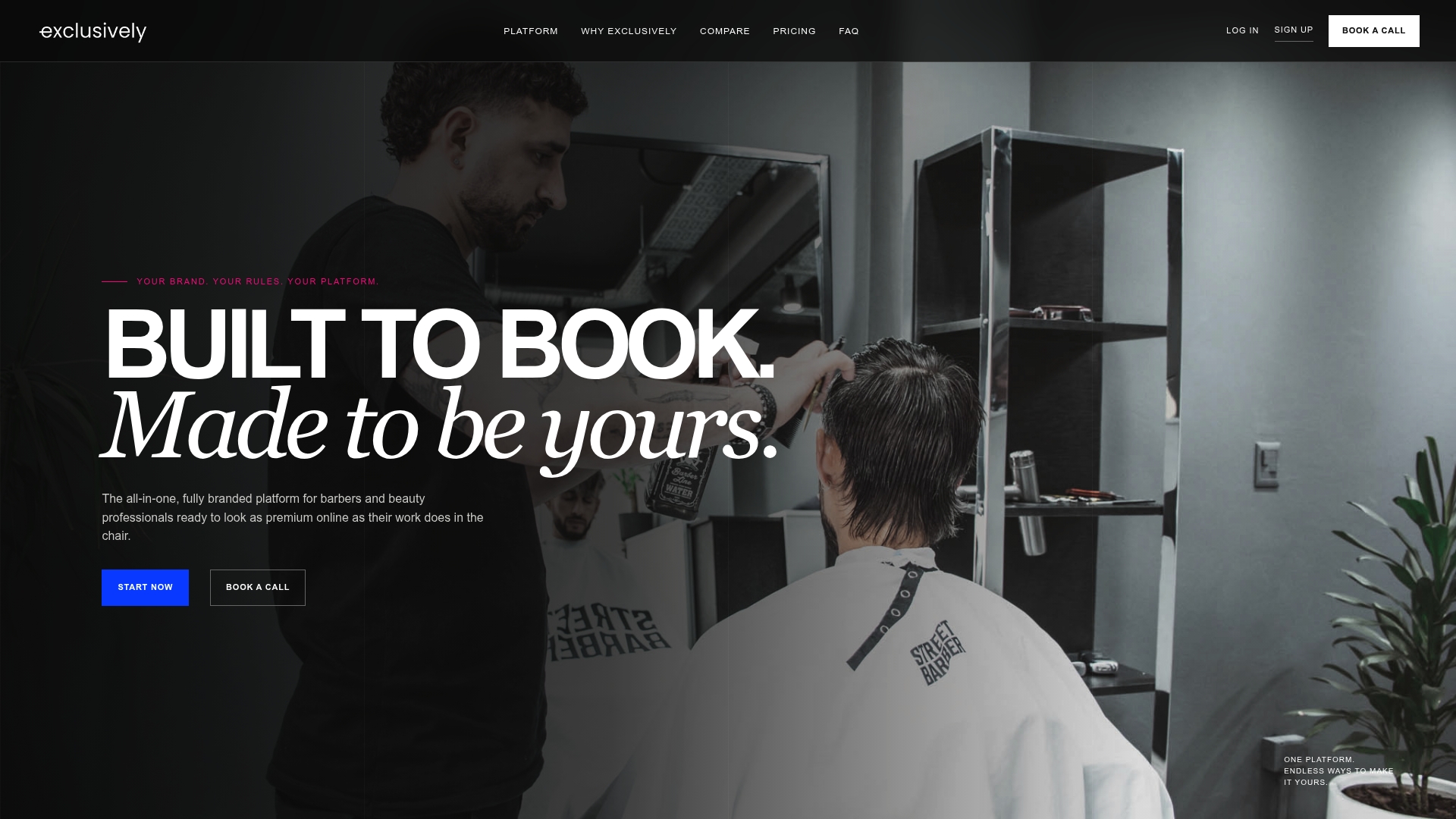
If you run a suite, a multi-chair shop or a training program, the same setup lets each professional run their own calendar and pricing under one brand, so every text you send can point to the right person’s booking page.
A 30-day plan to start
- Week 1: Add a consent checkbox to your booking form and start asking at the chair. Write your STOP language.
- Week 2: Turn on confirmations and day-before reminders. Check that every link opens straight to booking.
- Week 3: Pull a list of clients who have not been in for 60 to 90 days, only those who opted in, and send the first win-back text.
- Week 4: Review bookings from text links, no-shows and opt-outs. Adjust timing, then add one promotion.
Keep the list clean and the messages rare. A text that arrives twice a month and says something useful will be read for years.
FAQ
Do I need written permission to text my barbershop clients?
For marketing texts in the US, yes: the TCPA calls for prior express written consent with clear disclosure, and a client giving you their number to book is not the same thing. Add a checkbox or text-to-join step and keep a record. For legal questions about your shop, ask a lawyer who handles marketing compliance.
How many marketing texts a month is too many?
Start with one or two promotional texts a month and treat three or four as a ceiling. Never send more than you told clients at sign-up. Appointment reminders and confirmations are separate and do not count toward that cap.
What time of day should I send texts?
Stay between 8 a.m. and 9 p.m. in the client’s time zone, and earlier-closing or later-opening windows apply in some states such as Florida, Oklahoma and Texas. For most shops, late morning for rebooking nudges and the evening before for reminders is a sensible default.
When should I text a client who has not come in?
A common trigger is 60 to 90 days without a visit, though a client with a three-week cycle may be overdue sooner. Send a warm check-in first, an update second and a soft offer last, over two to three weeks, then stop.
Sources
- Cost-Effective Marketing Strategies for Your Barbershop, National Barber Association
- TCPA text messages: Rules and regulations guide for 2026, ActiveProspect
- Use of data for marketing, CAP Code section 10, UK Advertising Standards Authority