
What Barbershop Branding Really Means for Your Chairs
What Barbershop Branding Really Means for Your Chairs

Barbershop branding is the consistent name, look, voice, and in-shop experience that turns a first-time walk-in into a client who rebooks without thinking twice. Get it right and every touchpoint, from your sign to your Instagram grid, tells the same story before a client ever sits in the chair.
Four moves matter more than the rest:
- Lock in your name and one-line positioning before touching a logo file.
- Build a visual system (logo, colors, type) that holds up small on a phone screen and large on a storefront sign.
- Make your interior and staff presentation match the promise your marketing makes.
- Sync your booking link, Google Business Profile, and Instagram so a stranger can find you, trust you, and book in under a minute.
The test of whether any of this worked is simple: does a client recognize your shop the same way whether they see the sign, the app, or a staff member’s apron?
Key Takeaways
Barbershop branding works when a clear positioning statement, a small-format-tested logo system, and a documented style guide stay consistent across signage, staff presentation, and every digital touchpoint.
| Point | Details |
|---|---|
| Positioning comes first | Write your one-line audience plus offer plus differentiator statement before designing any visuals. |
| Design for the smallest format | Test your logo at 24 to 48 pixels and as a single-color embroidery version before finalizing it. |
| Document one style guide | A single page covering colors, type, spacing, and voice prevents inconsistent application later. |
| Rituals build loyalty faster than gimmicks | Small, repeated service touches nobody else offers create stronger recall than flashy one-off promotions. |
| Track three numbers monthly | Watch booking volume, Google Business Profile views and reviews, and Instagram engagement with rebooking rate. |
| Keep the platform on-brand | Getexclusively publishes your branded website, booking flow, and mobile app under your own shop identity rather than a generic marketplace look. |
Table of Contents
- The Seven-Step Barbershop Branding Framework
- Building a Logo, Palette, and Type System That Scales
- How Do You Pick a Barbershop Name That Works?
- What Should Your Signage and Interior Say?
- Turning Your Website and Instagram Into Booking Machines
- Rolling Out Your Brand Over Six Months
- Why Storytelling Sells More Than Your Service Menu
- Setting the Tone: How Your Shop Should Sound Everywhere
- Designing Rituals That Clients Actually Remember
- Who Are You Actually Cutting Hair For?
- Standing Out From Every Other Shop on the Block
- Is Your Branding Actually Working?
- Why Most Shops Get the Order Backward
- How Exclusively Keeps Your Brand Consistent Online
- Sources
The Seven-Step Barbershop Branding Framework
Skipping steps is why so many shops end up with a nice logo and nothing else that matches it. Work through these in order, because each one sets up the next.
- Name and positioning. Decide who you serve and what makes you different before you design anything.
- Visual identity. Logo, color palette, typography, and a compact submark for small applications.
- Style guide (a few days, usually bundled with design work). One page documenting colors, fonts, spacing, and do’s/don’ts.
- Signage and interior. Apply the identity to what clients see the moment they walk in.
- Staff presentation and merch (ongoing). Aprons, business cards, branded combs.
- Digital presence. Website, booking link, Google Business Profile, Instagram.
- Marketing rhythm (ongoing). Consistent posting, review requests, and follow-up messaging.
Identity comes before application, and application comes before marketing, because you can’t market a look that doesn’t exist yet, and you can’t apply a system nobody’s documented. Designers who work this category consistently push clients toward building a full brand system rather than chasing one clever logo mark, precisely because a system with rules for application survives contact with signage, embroidery, and social media in a way a standalone graphic never does.
Pro Tip: Do steps 1 through 3 yourself or with a freelancer before you ever call a sign shop or uniform vendor. Vendors execute a brand; they rarely help you define one, and paying for signage twice because your logo changed midstream is a real cost, not a hypothetical.
Building a Logo, Palette, and Type System That Scales
A logo that looks sharp on a mockup and falls apart on a hat or a phone screen isn’t a finished brand mark, it’s a first draft. Design for the smallest use case first: your logo needs to read clearly as a rounded avatar at 24 to 48 pixels, since that’s the size it’ll sit at on Instagram, Google Business Profile, and your booking app. If it turns into a blur at that size, simplify it before you do anything else.
Embroidery adds its own constraints. Thread can’t render fine detail or gradients, so most shops need a single-color, simplified version of their mark specifically for aprons, hats, and patches. Designers who specialize in this space recommend building that flat, one-color version from day one rather than trying to reverse-engineer it later.
Color and type should match your positioning, not your personal taste. A premium, appointment-only shop tends toward matte blacks, brushed metallic accents, and high-CRI lighting that reads as controlled and deliberate, the same visual language high-end barber brands lean on to justify premium pricing. A craft or heritage shop often works better with warm woods, deep reds or greens, and a serif or slab typeface that feels traditional. A family-friendly shop usually does better with brighter, friendlier colors and rounder type.
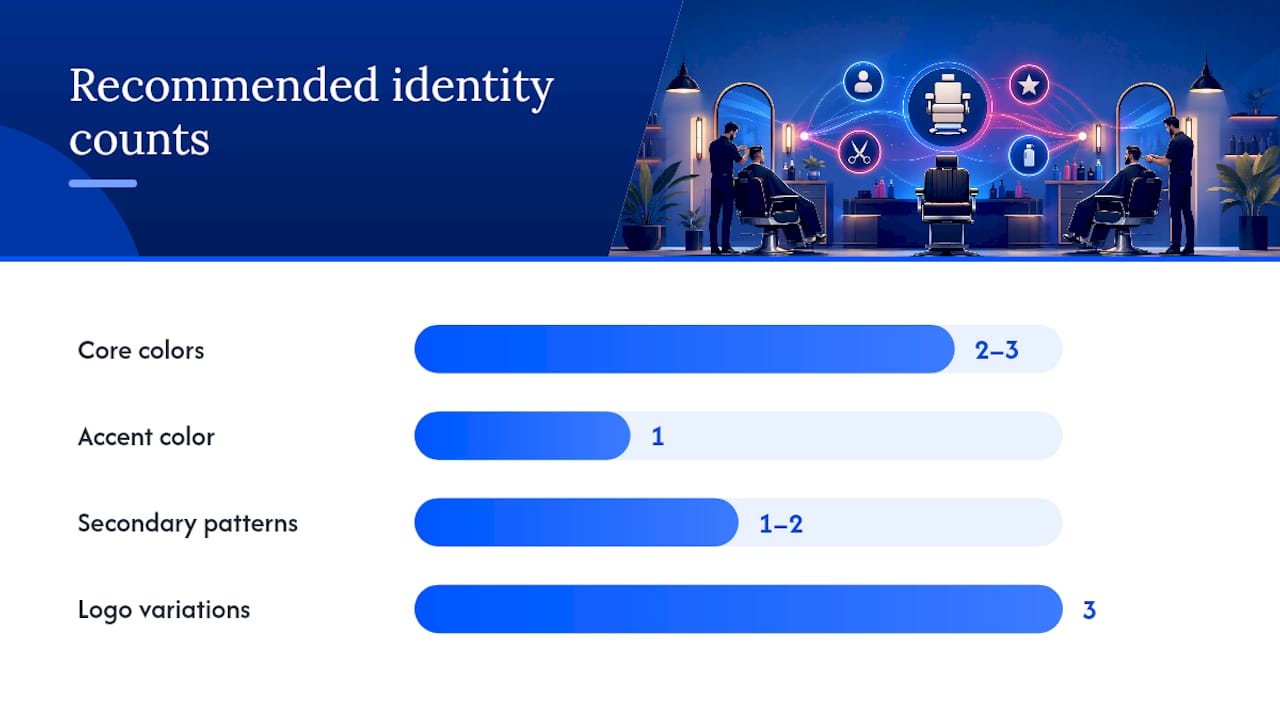
Beyond the primary logo, build a compact submark (an icon-only version for avatars and small merch), one or two secondary patterns, and a single accent color you can swap in for seasonal promotions without touching the core identity. Document all of it, spacing rules included, on one page.
- Test every version at business-card size and avatar size before approving it.
- Keep clearspace rules simple: enough room around the mark that it never touches text or edges.
- Limit your palette to two or three core colors plus one flexible accent.
Pro Tip: Print your logo on a plain white mug or apron before you commit to a final file. If it looks muddy or illegible off-screen, fix it now, because that’s exactly how clients will see it in real life.
How Do You Pick a Barbershop Name That Works?
Your name and positioning statement should come before any visual work, because they decide what the visuals need to communicate. Run every name candidate through a short checklist:
- Can someone recall and spell it correctly after hearing it once?
- Is the matching domain, or a close variant, and the Instagram handle actually available?
- Does it clash with another shop already established in your city or neighborhood?
- Does it hint at your specialty (fades, classic cuts, grooming lounge) without boxing you in permanently?
Once the name holds up, write a one-line positioning statement using this formula: audience plus primary offer plus differentiator. Something like “Busy professionals get precision fades and a 20-minute express slot, no appointment guesswork.” That single line should quietly steer your pricing tier, whether your chairs feel premium or approachable, and even the language on your booking page.
What Should Your Signage and Interior Say?
Your storefront and interior are the moment your branding either gets proven or exposed as marketing talk. Signage needs to hold up at a distance: high-contrast colors, materials that don’t fade in direct sun, and lighting that keeps your name legible after dark.
Inside, materials and lighting choices signal your price tier before a single word is spoken. High-end shops lean on matte black finishes, brushed metal fixtures, and high-CRI LED lighting at each station, treating every chair as its own stage that communicates technical mastery.
- Uniform aprons and consistent staff presentation reinforce the brand every single day, not just on launch week.
- Branded business cards and small merch (combs, stickers) extend the identity past the shop’s walls.
- Consistency across stations matters more than any single expensive fixture.
Turning Your Website and Instagram Into Booking Machines
Your digital presence is where most new clients meet your brand before they ever meet you. A shop website doesn’t need to be complex, but it does need services and pricing listed clearly, a working booking link, real photos of your actual space and staff, and short staff bios that give a new client a reason to pick a specific barber.
Instagram is where branding either converts or gets scrolled past. Before-and-after photos, short reels of the cutting process, and staff spotlight posts consistently outperform generic promotional graphics, and using a consistent color treatment or filter across posts makes your grid instantly recognizable even in a fast scroll.
Your Google Business Profile deserves as much attention as your feed. Barbershop marketing increasingly runs as a three-part system: get found through a complete, review-rich GBP listing, convert that visibility into a booking, then retain the client with follow-up. Responding to reviews and messages quickly isn’t a nice extra; automation and fast responses measurably cut lead loss for shops that take bookings by message.
- List services, pricing, and a booking link somewhere obvious on your homepage.
- Post consistently, not sporadically. A weekly rhythm beats a burst of ten posts followed by silence.
- Reply to every review, good or bad, within a day if you can manage it.
Rolling Out Your Brand Over Six Months
A brand overhaul fails when it’s treated as a weekend project instead of a sequence. Spread it across six months and the order does the heavy lifting for you.
- Months 1 to 2: Finalize name, positioning, and full visual identity (logo, colors, type, style guide).
- Months 2 to 3: Apply the identity to signage and interior touches, and order staff uniforms and business cards.
- Months 3 to 4: Launch or rebuild your website and booking flow, then align your Instagram visuals to match.
- Months 4 to 5: Push Google Business Profile completeness, request reviews, and set up automated booking follow-up.
- Months 5 to 6: Review early metrics and adjust merch, content, or messaging based on what’s actually working.
Cost bands vary widely depending on how much you outsource:
Three numbers tell you whether it’s working: booking volume, Google Business Profile views and review count, and Instagram engagement paired with your rebooking rate. If all three are flat after two months, something in the sequence above got skipped or rushed.
Why Storytelling Sells More Than Your Service Menu
Nobody rebooks because of a fade technique alone. They rebook because they felt something, remembered it, and wanted to feel it again. That’s the entire case for storytelling in barbershop branding: a service list tells a client what you do, but a story tells them why it matters to you and, by extension, to them.
The strongest shop stories are specific, not aspirational. “We started cutting hair in a garage because the local shop closed and the neighborhood needed one” works because it’s concrete and checkable. “We’re passionate about excellence in grooming” works for no one, because it could describe any shop on the block.
Use story in three places consistently. Your About section should explain why the shop exists, not just when it opened. Your Instagram captions should occasionally step away from before-and-after photos to show a staff member’s background, a regular client’s long history with the shop, or a small moment from a normal Tuesday. Your in-shop conversation, the actual words your barbers use while cutting, should echo the same themes your marketing pushes, because a client who hears one story online and a completely different vibe in the chair notices the gap immediately.
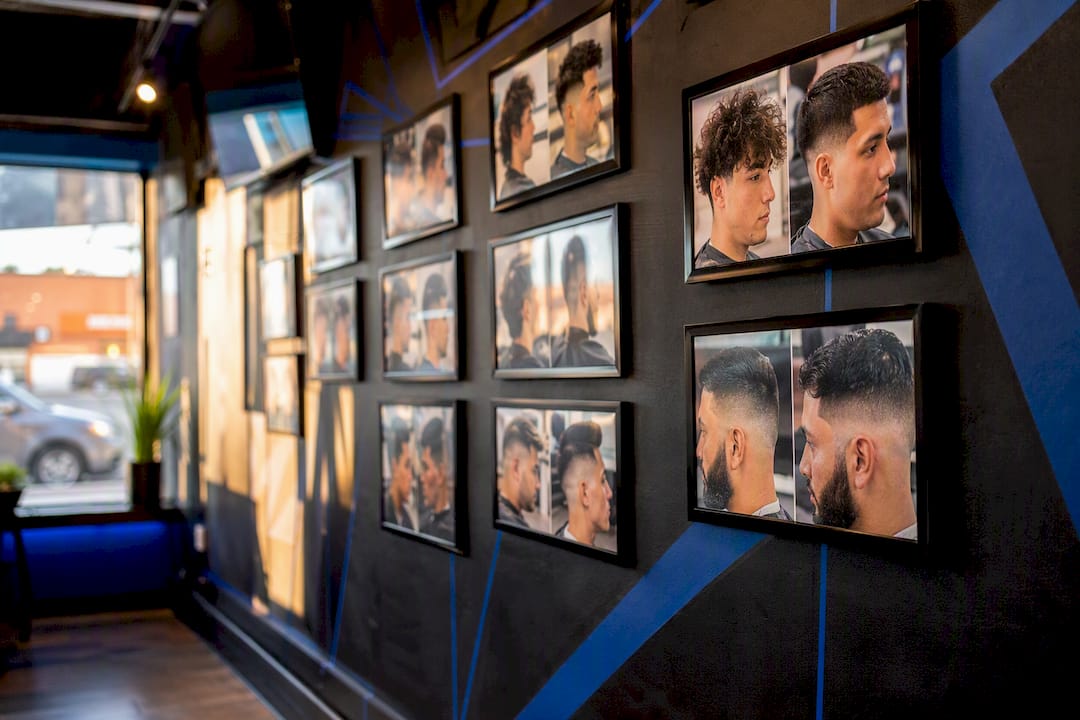
Photos do a lot of this work without needing captions at all. A wall of framed before-and-afters spanning years tells a story of consistency. A single photo of the founder’s first chair, kept visible near the entrance, does more emotional work than a paragraph of copy ever could.
Setting the Tone: How Your Shop Should Sound Everywhere
Brand voice is the personality behind your words, and tone is how that personality shifts depending on the moment. A shop with a playful voice still needs a serious tone when responding to a complaint, and a premium shop with a polished voice can still sound warm in a birthday message to a regular client.
Start by picking three adjectives that describe how your shop should sound: confident, no-nonsense, and welcoming, for example. Every caption, text reminder, and review response should be checked against those three words. If a message sounds like it could’ve come from any shop in town, it’s probably drifted from your intended voice.
Consistency across channels matters more than cleverness in any single post. Booking confirmations, Instagram captions, and the way your front desk answers the phone should all sound like the same shop talking, even though they’re different people and different formats. Write the three adjectives on the inside of your style guide, right next to your color codes, so new staff can absorb the tone as easily as they absorb the visual rules.
Small choices carry a surprising amount of voice. Do you sign texts with the barber’s first name or the shop name? Do captions use exclamation points or stay flat and confident? Pick once, document it, and stop relitigating it every time someone new writes a caption.
Designing Rituals That Clients Actually Remember
A haircut is a service. A ritual is the small, repeatable sequence around it that a client starts to expect and eventually misses when it’s gone. The shops that build genuine loyalty usually aren’t the ones with the best technical cuts, they’re the ones that added two or three small, consistent touches nobody else bothers with.
That could be a hot towel at the same point in every cut, a specific drink offered on arrival, or a closing line every barber says the same way. None of these cost much. What they cost is discipline, because a ritual only works if every barber does it every time, not just when they remember.
Rituals also give your branding something to talk about that competitors can’t copy overnight. Anyone can buy the same clippers. Almost nobody bothers to standardize the small human moments around the service, which is exactly why doing it consistently sets a shop apart. Document the ritual the same way you document your logo rules, because new hires need to learn it the same way they learn your fade standards.
Who Are You Actually Cutting Hair For?
Branding decisions get easier the moment you stop designing for “everyone” and start designing for two or three actual client types. A shop trying to appeal to busy executives, teenage skaters, and retired regulars all at once usually ends up with a bland identity that fully satisfies none of them.
Build two or three personas based on real patterns in your current client base, not guesses. A useful persona includes their age range, why they come in (maintenance versus a full transformation), how often they book, and what they value most, whether that’s speed, conversation, or precision. A “20-something professional who books every three weeks for a tight fade before Monday meetings” is a persona you can actually design around.
Once personas exist, they should shape real decisions: which photos go on Instagram, what your waiting area looks like, what your booking page’s language sounds like, and even your price tiers. A shop serving mostly busy professionals should emphasize fast, reliable booking above almost everything else. A shop serving style-focused younger clients should lean harder into visual content and trend-forward services.
Standing Out From Every Other Shop on the Block
Most barbershops within a few miles of each other look interchangeable online: similar fonts, similar stock-style before-and-afters, similar generic taglines about quality and craftsmanship. That sameness is your opportunity, not a wall to climb over.
Spend an afternoon actually looking at three or four competing shops’ Instagram, Google Business Profile, and website. Note what they all seem to be saying and doing the same way, then commit to doing at least one of those things noticeably differently. If every shop nearby uses a dark, moody aesthetic, a bright, warm one might actually stand out more than blending in with better production value.
Differentiation doesn’t require inventing a new service. It usually comes from combining an existing strength (a specific cut style, a neighborhood history, a specialty in curly or textured hair) with a visual and voice identity nobody else in the area has claimed yet. Write down exactly what makes your shop different in one sentence, and if you can’t finish that sentence honestly, that’s the gap to close before spending another dollar on marketing.
Is Your Branding Actually Working?
Branding that never gets measured is just decoration. Track a small handful of numbers monthly instead of chasing vague impressions of whether things “feel” better.
Booking volume is the bluntest signal: is it trending up month over month since your rebrand launched? Google Business Profile views and review count tell you whether your local visibility is improving. Instagram engagement combined with your actual rebooking rate tells you whether your content and in-shop experience are landing, not just getting likes.
Beyond the numbers, ask clients directly. A short comment card at checkout, or a quick question a barber asks casually (“Anything about booking or the shop we could make easier?”), surfaces feedback that dashboards miss entirely. Take the recurring complaints seriously even when they’re minor, because the same small friction repeated across dozens of clients is a branding problem hiding as a customer service note.
Why Most Shops Get the Order Backward
Most barbershops treat branding as decoration they add after the business is already running, which is exactly backward. The name, the positioning line, and the visual system should exist before the first Instagram post, not get retrofitted six months later when the feed already looks inconsistent.
The conventional advice oversells the logo and undersells the system. A striking logo means nothing if it turns illegible on an apron patch or if your Google Business Profile still lists the wrong hours. Consistency across every small touchpoint, staff shirts, booking confirmations, review replies, does more for client trust than a expensive redesign ever will.
If you’re a busy owner reading this looking for one place to start, start with the one-page style guide and the booking link. Everything else, signage, merch, Instagram tone, gets easier to execute once those two things are locked. And once the identity exists, the platform carrying it online matters just as much as the identity itself. A brand that looks sharp on a sign but sloppy on a generic booking page is still an inconsistent brand.
— Service
How Exclusively Keeps Your Brand Consistent Online
Once your logo, colors, and voice are locked, the harder problem is keeping them consistent across a website, a booking flow, and a mobile app without hiring a developer every time something changes. Getexclusively is built specifically for that gap: a fully branded platform that puts your shop’s name, colors, and identity on your own website and native app rather than burying you inside a generic booking marketplace.
Each barber on your team keeps control over their own pricing, availability, and service menu, while the shop’s overall look stays unified across every screen a client touches. Built-in Square payments, membership tools, and marketing features mean the booking and payment experience matches the same premium feel you built into your signage and Instagram grid, instead of dropping clients into a third-party interface that looks nothing like your shop.
If you’re comparing platforms, the feature breakdown against SQUIRE shows where branded control makes a real difference for growing shops. Check the pricing page to see which plan fits your shop’s size and start publishing a site that actually looks like yours.
Sources
- Cut Above the Rest: 10 Smart Branding Concepts for Salons & Barbershops
- Building a High-End Barber Brand Identity: The 2026 Professional Guide – BarberNation
- Barbershop Marketing in 2026: Get Found, Booked and Keep Clients Coming Back