
30–90 Day Barbershop Marketing Plan for Solo Owners: Google and Rebooking
30–90 Day Barbershop Marketing Plan for Solo Owners: Google and Rebooking

The fastest path to more bookings is a tight sequence: verify and fully build out your Google Business Profile, lock in a rebooking habit with a simple loyalty system, and publish a mobile-friendly booking page with real portfolio photos. Most of this takes a few hours over one weekend and costs little to nothing. Track just two numbers at first: bookings by source and your rebooking rate.
TL;DR:
- Focusing on verifying and regularly updating your Google Business Profile, especially with fresh photos and reviews, is critical for local visibility and search ranking.
- Building a simple, mobile-friendly online booking page with a prominent button and real portfolio photos can drastically reduce friction and increase conversions.
- Implementing a straightforward loyalty or rebooking system encourages repeat visits and improves your rebooking rate, which directly impacts revenue.
- Maintaining a consistent weekly social media schedule with reels and before-and-after photos enhances engagement and attracts nearby clients organically.
- Tracking key metrics like bookings by source, rebooking rate, and revenue per chair helps refine your strategy and set achievable, measurable goals.
Table of Contents
- Priority marketing actions for barbershops ranked by impact
- Local SEO and Google Business Profile: verify, optimize, and build reviews
- Website and online booking basics that convert
- Social media content that converts followers into bookings
- Promotions and loyalty: simple, high-ROI retention tactics
- Partnerships, events, and community marketing that build local awareness
- Measure and budget: KPIs, SMART goals, and a lean monthly spend example
- 30 to 90 day action plan: week-by-week starter roadmap
- Why these tactics work: Google, SBA guidance, and what practitioners see
- Owning your booking data changes how your marketing compounds
- An optional way to run the plan from one branded platform
- FAQ
- Sources
Priority marketing actions for barbershops ranked by impact
Work through these in order. Each one builds on the last, and none requires a marketing budget to start.
- Claim and verify your Google Business Profile (30 to 60 minutes, free): confirm your address, phone, and hours so you show up in “barbershop near me” searches.
- Add 15 to 20 real photos of cuts, the shop interior, and your chair setup (30 minutes, free): profiles with photos get more attention from people scrolling on their phones.
- Set up a review request flow using a link or QR code at checkout (20 minutes, free): aim for a steady trickle of new reviews rather than a one-time push.
- Build a simple rebooking script your staff uses at checkout (15 minutes to write, ongoing): ask “same time next month?” before the client leaves the chair.
- Publish a mobile-friendly booking page with a visible button (half a day, free to low-cost): remove every extra click between “interested” and “booked.”
- Add a staff portfolio page with before-and-after shots per barber (1 hour, free): clients often pick a barber by style, not just location.
- Post two to three times a week on social media using reels and before-and-afters (2 to 3 hours weekly, free): consistency beats polish here.
- Launch a basic loyalty or punch-card system (1 hour to set up, low-cost): a free haircut after ten visits is easy to track and easy to explain.
- Partner with one nearby business for a cross-promotion (1 hour outreach, free): a coffee shop or gym referral costs nothing but a conversation.
- Set a 90-day goal and check it weekly (15 minutes a week, free): watch bookings by source and rebooking rate, and adjust whatever isn’t moving.
Local SEO and Google Business Profile: verify, optimize, and build reviews
Your Google Business Profile is the single highest-leverage asset you have, and most of it costs nothing but time. Start with verification, then fill in every field Google offers.
- Pick the most specific category available, such as “barber shop,” rather than a generic “hair salon” label.
- List every service you offer with prices if you’re comfortable sharing them, since Google surfaces this in search results.
- Keep your hours accurate, including holiday hours, so people don’t show up to a locked door.
- Upload fresh photos monthly: a shop that looks active signals current, trustworthy information.
- Ask for reviews with a direct link or a printed QR code at the counter, and reply to every review, good or bad, within a few days.
Google’s own guidance on local ranking factors explains that relevance, distance, and prominence determine who shows up first, and a complete profile with steady reviews directly supports prominence. Never offer a discount in exchange for a review: Google’s policy on getting reviews treats that as misleading and prohibited, so ask plainly and let the review stand on its own.
Mobile search behavior backs up this priority. Think with Google’s research on mobile search found that A significant majority of people who search for something nearby on their phone visit a business within a day, and a substantial portion of all mobile searches are tied to location. A barbershop that’s easy to find and looks current on Google captures a real share of that same-day traffic.
Website and online booking basics that convert
Your website doesn’t need to be elaborate. It needs to remove friction between a phone search and a booked appointment.
- A visible booking button on every page, not buried in a menu.
- Click-to-call phone number at the top of the page for people who’d rather talk than click.
- A services and pricing page so clients know what to expect before they arrive.
- A staff portfolio with photos tied to each barber’s name and specialty.
- Online booking that syncs with your actual schedule, so double-bookings don’t happen.
A free page builder or a basic site can cover the essentials, but booking software matters more than the design itself: it captures client contact details automatically, which makes rebooking reminders and loyalty tracking far easier to run. If you’re managing bookings across texts, walk-ins, and a third-party app, a branded website that centralizes everything in one place removes a lot of the daily juggling.
Social media content that converts followers into bookings
Social media works for barbershops when it’s treated as a portfolio, not a diary. Keep the format simple and repeatable.
- Short reels of a cut from start to finish, 15 to 30 seconds, work better than long clips.
- Before-and-after photos posted as carousels get saved and shared more than single images.
- Client features, with permission, build trust faster than a shop talking about itself.
- Quick tips, like how to maintain a fade between visits, position you as the expert.
A simple weekly cadence, say two reels, one carousel, and one story, keeps your feed active without eating your whole week. Repurpose the same reel across Instagram, TikTok, and Facebook instead of filming three separate versions. Tag your location and use local hashtags so nearby searchers find you organically, and keep your booking link in your bio where it’s one tap away.
Pro Tip: Film three cuts in one sitting on a slow afternoon, then space the posts out over the week.

Promotions and loyalty: simple, high-ROI retention tactics
Acquiring a new client costs more effort than keeping one you already have, and a modest, well-run loyalty system often does more for revenue than a flashy one-time promotion.
- Set up a punch-card or app-based loyalty tier, like a free cut after every tenth visit, and keep the rule simple enough to explain in one sentence.
- Run limited-time offers on your slowest weekdays, such as a discount for Tuesday morning bookings, to smooth out your schedule.
- Send a rebooking reminder text or email a few days before a client’s typical cycle ends, timed to when they’re likely due for a trim.
- Avoid discounting your busiest hours: protect full price where demand is already strong and use promotions to fill the gaps instead.
The SBA’s guidance on marketing to existing customers points out that small businesses typically put far more effort into chasing new clients than keeping current ones, even though retention tactics like these often perform better per dollar spent.
Partnerships, events, and community marketing that build local awareness
Cross-promotions with nearby businesses cost little and bring in clients who already trust a name they recognize.
- Partner with a gym, coffee shop, or barbershop-adjacent business like a tattoo studio, and offer each other’s customers a small discount or bundled deal.
- Host a simple in-shop event, like a kids’ back-to-school cut day or a father’s day special, and promote it across your shop, your social feeds, and your partner’s channels.
- Ask new clients at checkout how they heard about you, so you can track how many came from the event or partnership directly.
A local decor partner like Noirci Studio can also be a simple collaboration for shops looking to refresh their space or run a small retail cross-sell during an event.
Measure and budget: KPIs, SMART goals, and a lean monthly spend example
Track a small number of numbers consistently rather than a dashboard full of metrics you’ll never check.
- Bookings by source: track whether clients come from Google, social media, or referrals.
- Rebooking rate: the percentage of clients who book their next visit before leaving.
- New client count: how many first-time visitors you get each month.
- Revenue per chair: a simple way to see which barbers or hours are underperforming.
The SBA recommends setting SMART goals, meaning specific, measurable, achievable, relevant, and time-bound targets, and checking progress weekly rather than waiting until the end of the quarter. For month one, a lean split might put most of your effort into free GBP and content work, with a small amount, even $20 to $50, toward boosting one strong-performing social post to a local audience.
30 to 90 day action plan: week-by-week starter roadmap
- Week 1: verify your Google Business Profile, upload fresh photos, publish your booking link everywhere, and announce a rebooking incentive to current clients.
- Weeks 2 to 4: start your weekly content cadence, launch your loyalty or punch-card system, and test one small paid boost on your best-performing post.
- Month 2: review your KPIs, keep whatever is working, and cut whatever isn’t getting engagement or bookings.
- Month 3: run one local event or partnership promotion, and reassess your 90-day goal before setting the next one.
Why these tactics work: Google, SBA guidance, and what practitioners see
These priorities aren’t guesswork. Google’s own ranking guidance ties local visibility to relevance, distance, and prominence, which a complete profile and steady reviews directly support. The SBA’s small business marketing guide emphasizes SMART goals and notes that retention spending is often underused relative to its return.
- Practitioners who work with independent shops consistently prioritize GBP and rebooking before any paid advertising.
- Foundational, free tactics, a complete profile, steady reviews, and a rebooking habit, tend to outperform early paid ad spend.
- Niche-focused promotion, speaking directly to a specific type of client, builds trust faster than broad, generic advertising.
Owning your booking data changes how your marketing compounds
A consistent brand and a direct booking path do more than look professional: they keep client contact information in your hands instead of scattered across third-party apps. That matters most once your rebooking and loyalty systems are running well and you want every repeat visit tracked in one place. An owner starts to feel this gap when client data, payments, and branding live in three different tools that don’t talk to each other.
— Service
An optional way to run the plan from one branded platform
Everything in this plan, GBP, rebooking, loyalty, and booking, can run on free or low-cost tools you piece together yourself. For shops that want it centralized under their own name instead of a generic directory listing, we built Exclusively around that need.
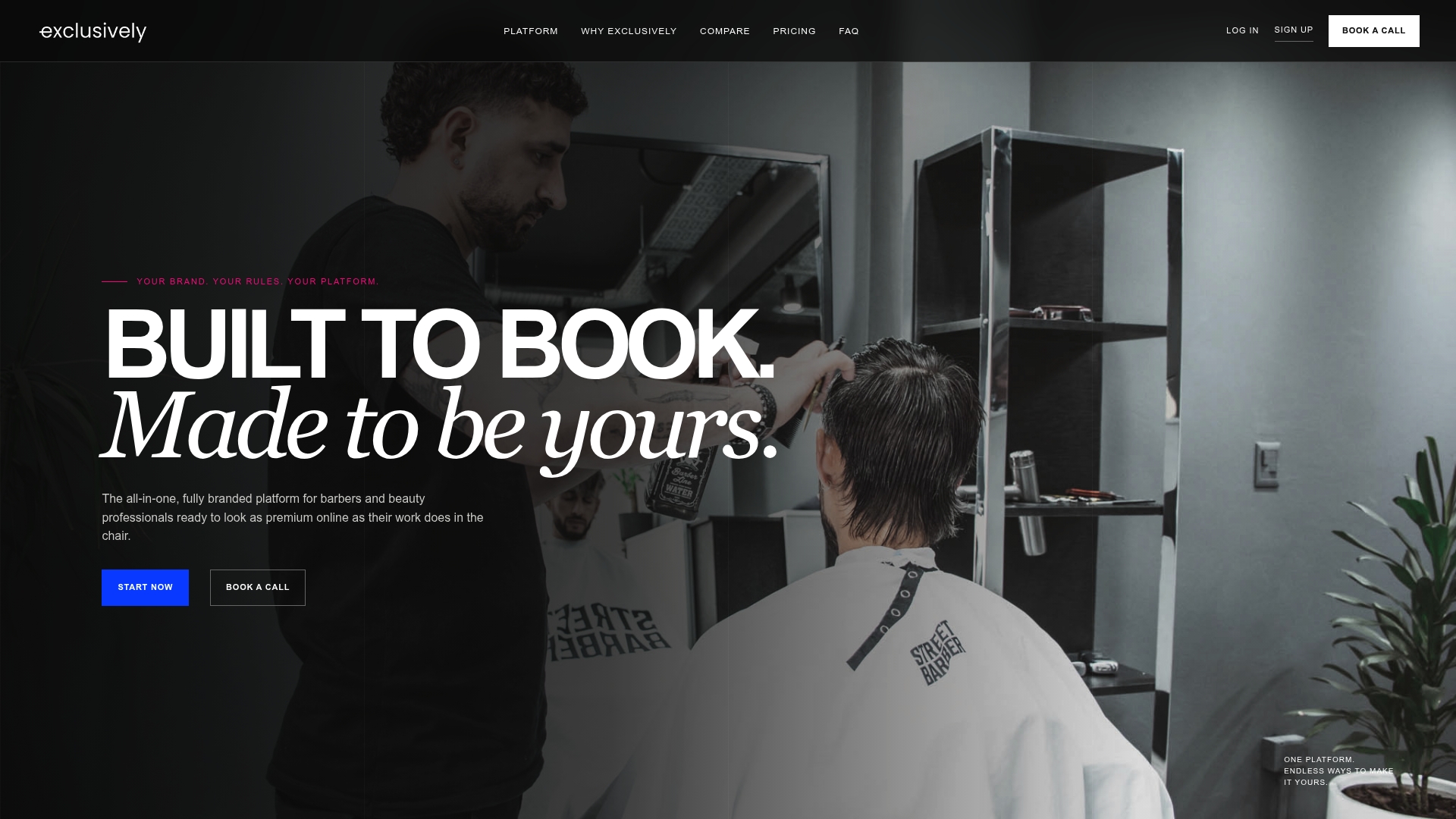
Our platform gives barbers and beauty professionals a branded website, native mobile apps, integrated booking, payments, and membership tools under their own name rather than a shared marketplace brand.
- A branded website with your own booking page, services, and staff portfolio in one place.
- Native mobile apps that help clients rebook and track loyalty without leaving your brand.
- Built-in membership tools for running the loyalty structures covered earlier in this plan.
- Provider-level control over pricing, availability, and service details.
Plans start with the Business Website at $49 per month, with Website + Booking at $199 per month and Website + Booking + Apps at $299 per month. If you’d rather talk through which fits your shop, you can book a call and walk through the options together.
FAQ
What are common mistakes to avoid at the barber?
The most common mistakes are an incomplete or unverified Google Business Profile, inconsistent rebooking habits, and a booking process that requires a phone call instead of a quick tap. Shops that skip review replies or let their photos go stale also lose visibility in local search over time.
How do I start a barber supply business?
Starting a barber supply business typically means sourcing wholesale products from manufacturers or distributors, securing a retail or online storefront, and building relationships with local shops as early customers. This is a distinct business from running a barbershop itself, and the licensing and supplier requirements vary by location, so check your local regulations before committing capital.
What are some catchy phrases for a barber shop?
Catchy barbershop phrases usually play on precision, tradition, or confidence, things like “Sharp lines, sharp life” or “Fresh cuts, fresh starts.” The strongest ones reflect your shop’s actual personality rather than a generic slogan, since that consistency is what makes a phrase memorable to repeat clients.
Is barbershop a good business to start?
A barbershop can be a solid business for someone willing to build a loyal client base, since repeat visits every few weeks create steady, predictable revenue. Success depends heavily on location, consistent rebooking habits, and local visibility, which is why foundational marketing steps like a complete Google Business Profile matter from day one.
Sources
- Tips to improve your local ranking on Google - Google Business Profile Help
- Mobile search trends: consumers to stores - Think with Google