
30 Day No Show Fix: Salon Booking Restrictions and Templates
30 Day No Show Fix: Salon Booking Restrictions and Templates
Set a card-on-file or deposit requirement for high-risk bookings, pair it with a cancellation window typically ranging from one day to two days, and allow a short grace period before treating a late arrival as a no-show. Of those three moves, requiring a card-on-file is the one that cuts no-shows fastest, because clients who’ve already handed over payment information rarely skip without a call. Everything below, including copyable templates and exact booking-system settings, builds from that one rule.
TL;DR:
- Requiring a card-on-file and a short cancellation window of one to two days significantly reduces no-shows, especially for high-risk, resource-heavy services.
- Policies should be tiered based on service risk, with longer cancellation windows and deposits for chemical treatments, bridal parties, or lengthy appointments.
- Configuring buffers, lead times, and maximum booking windows at the service level helps prevent calendar overlaps and last-minute booking chaos.
- Enforcing policies effectively depends on automatic system features like deposit capture, reminder cadences, and clear communication posted across booking touchpoints.
- Using a dedicated booking platform that supports these restrictions and automates enforcement ensures consistency and protects revenue with minimal manual oversight.
Table of Contents
- Why Salon Booking Restrictions Protect Revenue and Staff Time
- Core Policy Elements You Can Copy Today
- Setting Buffers, Lead Time, and Booking Windows That Actually Work
- Making Policies Stick: Where to Post Them and How to Enforce Them
- Copy-and-Paste Policy Language for Your Booking Page
- How Getexclusively Supports These Booking Restrictions
- Your 30-Day Plan to Cut No-Shows and Steady Your Schedule
- Getexclusively Turns These Rules Into Automatic Settings
- Where to Find More Policy Examples and Templates
- Sources
- FAQ
Why Salon Booking Restrictions Protect Revenue and Staff Time
A no-show doesn’t just cost you one service. It costs you the labor you scheduled for it, the client who could have filled that slot, and the momentum of your day. A 45-minute color slot that goes empty because someone forgot to cancel is 45 minutes your stylist is paid for but earns nothing from, and it’s a slot a waitlisted client would have happily taken.
That’s the math behind why deposits and card-on-file policies have become close to standard across the industry. Square’s guidance on salon booking policies treats deposits and stored cards as the backbone of enforceable cancellation rules, not an optional extra. Without a payment method attached to the booking, a cancellation fee is just a line in a policy document nobody pays.
Stricter rules do carry a tradeoff. Push the cancellation window too far out, say 72 hours for a routine haircut, and you’ll frustrate clients who book spontaneously and may not rebook at all. The goal is matching the restriction to the risk:
- Low-risk, short services (blowouts, quick trims): light restrictions, short windows.
- Mid-risk services (color, extensions add-ons): moderate deposit or card-on-file requirement.
- High-risk, long, or resource-heavy services (chemical treatments, bridal parties, multi-hour bookings): mandatory deposit, longer cancellation window.
Pro Tip: Run your no-show rate for the last 90 days by service type before you set any policy. If your color appointments no-show at triple the rate of your blowouts, that’s exactly where your deposit requirement needs to start.
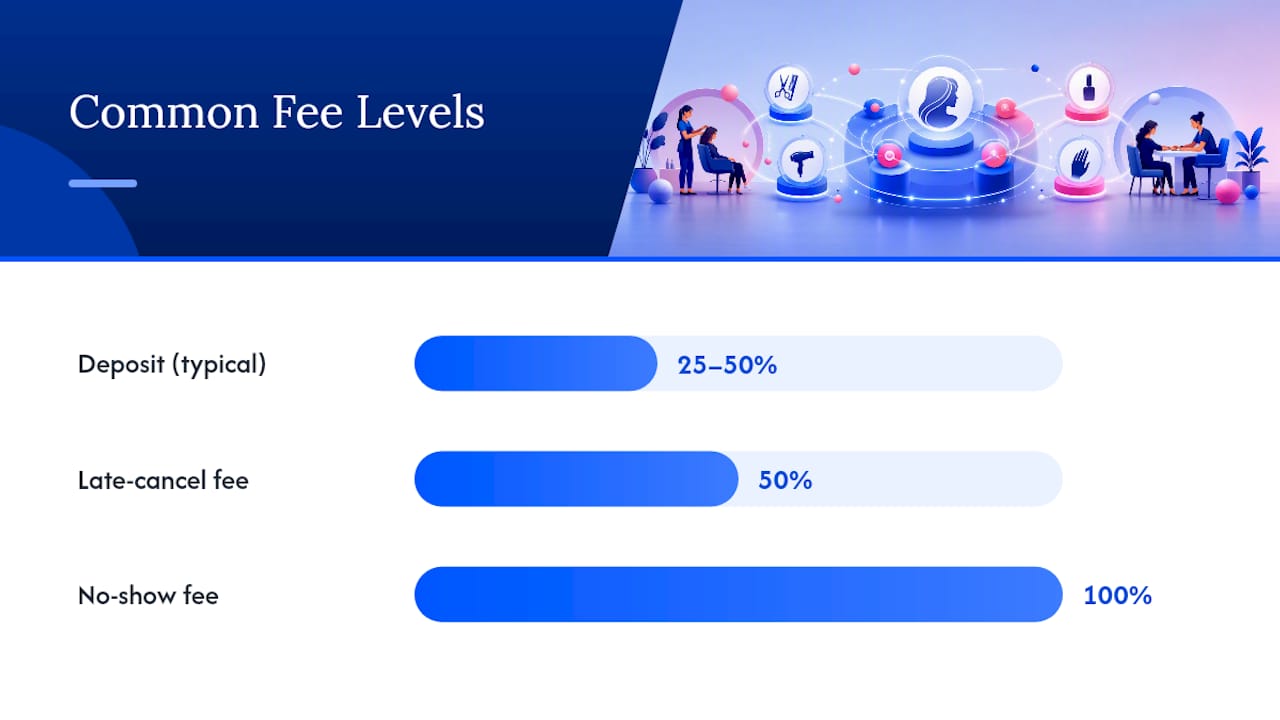
Industry examples back this tiering. One salon’s published guidelines require 24 to 48 hours’ notice, charge 50% for late cancellations, and 100% for true no-shows, with deposits reserved specifically for chemical services and extended bookings. That structure gives clients room to reschedule in good faith while still protecting the shop financially when someone simply doesn’t show.
Core Policy Elements You Can Copy Today
Every strong salon cancellation policy rests on five decisions: the notice window, the deposit type, the fee structure, the late-arrival rule, and which services trigger stricter handling. Get these five right and the rest of your booking restrictions fall into place.
Cancellation windows. A 24-hour window works well for single-service, sub-hour appointments where rebooking is quick. A 48-hour window fits longer or specialty services (extensions, bridal, chemical treatments) where filling the slot last-minute is harder. Some shops split the difference: 24 hours for regular services, 48 hours for anything over 90 minutes.
Deposit models. You have three real options:
- Percentage deposit (25 to 50% of service cost) — scales naturally with the value at risk, and is the standard for chemical services and long appointments.
- Flat-fee deposit — simpler to administer, works well for shops with fairly uniform pricing across services.
- Card-on-file with no upfront charge — lower friction at booking, but only works as a deterrent if clients understand the card will be charged for a violation.
Refund rules matter as much as the deposit itself. Most salon policies apply the deposit toward the final bill when the client shows up, and treat it as non-refundable (or partially refundable) only when the cancellation falls inside the notice window. One well-known example of this is a policy requiring a 50% non-refundable deposit specifically for chemical appointments, which protects the shop from the cost of holding a long, product-heavy slot that’s hard to rebook on short notice.
No-show and late-cancellation fees. A common and defensible structure:
- Cancel with proper notice: no charge, deposit applied to next booking.
- Cancel late (inside the window but not a full no-show): 50% of service price.
- True no-show (no notice at all): 100% of service price.
- Repeat offense (second no-show in a rolling period): required prepayment for all future bookings, or temporary booking suspension.
That escalation matters. A first-time no-show might be a genuine emergency. A third no-show in two months is a pattern, and your policy should treat it differently without you having to make an awkward judgment call each time.
Late arrivals. Set a grace period, typically 10 to 15 minutes, and be explicit about what happens after it. Options include shortening the service to fit the remaining slot, offering a partial service at full price, or treating the booking as a no-show if the client is more than 20 to 30 minutes late. Whatever you choose, apply it consistently, because inconsistent enforcement is what actually damages client trust, not the rule itself.
Service-specific triggers. Chemical services (color, perms, keratin treatments), extensions, and any appointment over 90 minutes should carry mandatory deposits by default. These are the bookings that cost you the most in blocked calendar time and product prep when they fall through.
Setting Buffers, Lead Time, and Booking Windows That Actually Work
Policy language only works if your booking system enforces it automatically. Three settings do most of the heavy lifting: buffers, minimum lead time, and the booking window.
A buffer is the built-in gap after an appointment that keeps your calendar from double-booking the cleanup, restocking, or reset time between clients. Buffer and scheduling guidance from YourSalon recommends setting buffers per service type rather than one blanket number, since a color service needs far more reset time than a quick trim. Per-service buffers, not a single global setting, are what actually prevent the day from sliding into chaos by 2 p.m.
Minimum lead time stops the “I’ll just book something in ten minutes” problem that blindsides your front desk and leaves no time to prep. Same-day cut-offs of 2 to 4 hours ahead give staff enough notice to pull product and review the client’s history.
| Setting | Typical practice | What it prevents |
|---|---|---|
| Buffer (quick services) | Several minutes | Back-to-back stacking with no reset time |
| Buffer (color/chemical services) | Longer than quick service buffer | Insufficient cleanup or product prep time |
| Minimum lead time | Ranges from shortly before to about a day | Last-minute bookings staff can’t prepare for |
| Same-day cut-off | Few hours before appointment | Walk-in-style bookings with zero prep window |
| Booking window (how far ahead clients can book) | Several weeks | Calendar clutter and speculative holds |
| Max bookings per provider per day | Based on stylist capacity | Staff burnout and service-quality drop-off |
Configure these per service, not just per shop. A quick trim might need only a 5-minute buffer and same-day booking enabled right up to an hour before. A full color and cut might need a 15-minute buffer, a 24-hour minimum lead time, and a mandatory deposit layered on top. Most modern scheduling platforms let you set these rules at the service level rather than forcing one setting across your entire menu, which is the difference between a calendar that runs itself and one your front desk has to babysit all day.
Making Policies Stick: Where to Post Them and How to Enforce Them
A policy nobody sees before booking isn’t a policy, it’s a surprise. Put your cancellation and deposit terms in three places: directly inside the booking flow (as a checkbox clients must agree to before confirming), on the confirmation page and email they receive right after booking, and on a dedicated policy page linked from your site’s main navigation.
Reminder timing does most of the practical work of preventing no-shows before you ever need to enforce a fee. A workable cadence:
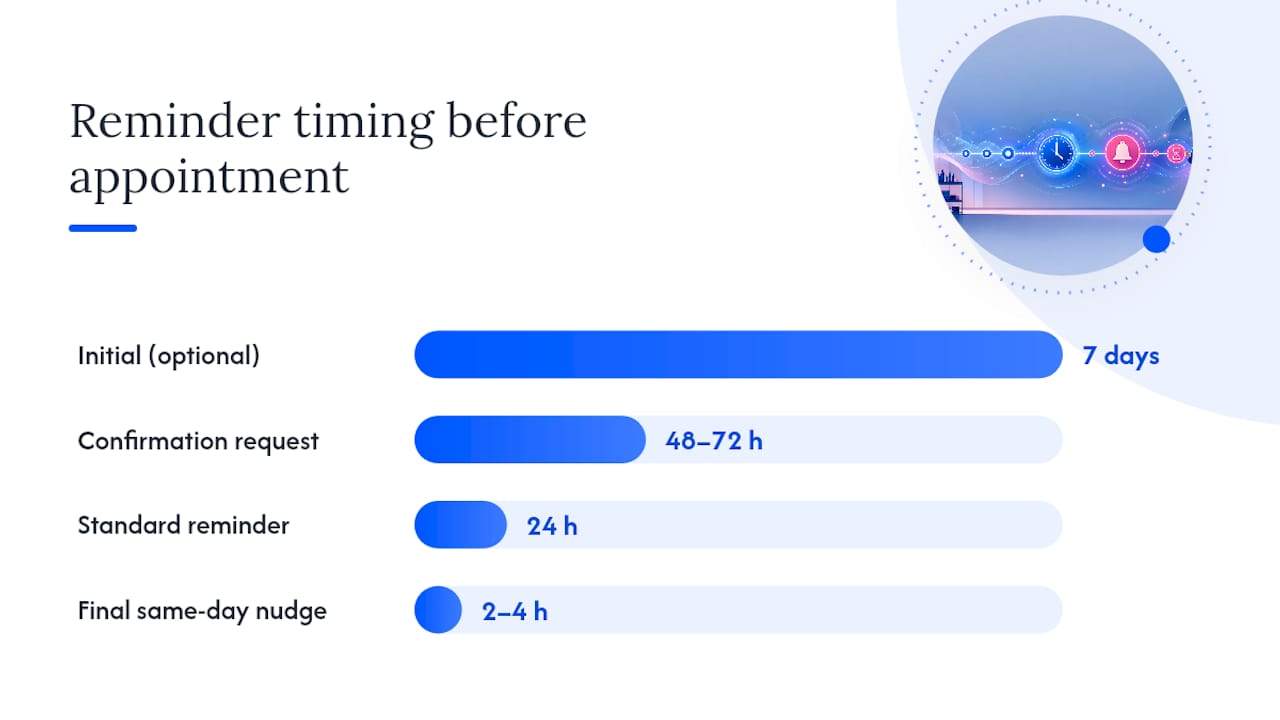
- 7 days out (optional, for high-value or long appointments): initial reminder with policy recap.
- 48 to 72 hours out: confirmation request, ideally requiring a tap or reply.
- 24 hours out: standard reminder via SMS or email.
- 2 to 4 hours out (same-day): final SMS nudge.
Booking-flow research from Zenoti points out that unclear service names and vague timing on your booking page create friction that raises cancellations even when your written policy is airtight. If a client isn’t sure whether “Balayage” means a 90-minute or 3-hour commitment, they’re more likely to book something they can’t actually keep, then cancel late.
Consent language in the booking flow should be short and specific: “I agree to the cancellation policy and authorize a charge to my card on file for late cancellations or no-shows.” Require the checkbox before the booking confirms, not after.
For staff, script the awkward moments in advance. When charging a no-show fee, a simple line works: “Because we didn’t receive notice before your appointment window closed, we’re applying the no-show fee outlined in our policy. I can walk you through rebooking whenever you’re ready.” Product Club’s guidance on salon policy enforcement recommends staying precise and polite rather than apologetic, since over-apologizing signals the policy is negotiable when it isn’t.
Pro Tip: Keep a shared log, even a simple spreadsheet, of every exception you grant and why. Consistency across shifts matters more than the exception itself; nothing erodes a policy faster than one stylist waiving fees that another enforces.
Copy-and-Paste Policy Language for Your Booking Page
Use these as starting drafts, not final copy. Adjust the numbers to match your own no-show data and service mix.
- 24-hour cancellation policy: “Cancellations made less than 24 hours before your appointment will be charged 50% of the service price. No-shows will be charged 100%. Deposits are applied toward your service when notice is given on time.”
- 48-hour deposit policy for chemical services: “Chemical services (color, perm, keratin) require a 50% deposit at booking. This deposit is non-refundable for cancellations made less than 48 hours before your appointment and will be applied to your final bill otherwise.”
- Late-arrival policy: “We hold appointments for 15 minutes past your scheduled time. After that, we may need to shorten your service or reschedule you, depending on availability.”
- Repeat-offender policy: “Clients with two or more no-shows within a 90-day period will be required to prepay for all future appointments before booking.”
How Getexclusively Supports These Booking Restrictions
The policies above are only as good as the system enforcing them. A branded booking platform needs to let you require deposits, store a card on file, and set different buffers for a quick trim versus a full color, all without a client ever leaving your own site or app.
The platform builds these controls at the provider level, so shops can configure deposits and buffers to match their own service menu rather than a one-size-fits-all default. That matters most on the services readers here already flagged as high-risk: chemical treatments, extensions, and anything over 90 minutes.
- Deposit and card-on-file capture built into the booking flow, tied to specific services.
- Per-service buffer and lead-time settings so a color appointment and a beard trim don’t share the same rules.
- Payment processing through Square or Stripe, covering how charges, refunds, and no-show fees actually move.
- Step-by-step booking help videos for setting up deposits and cancellation windows without a developer.
A shop enabling this for the first time might set a 50% deposit on color services, a 48-hour cancellation window, and a 10-minute buffer, all inside the same settings panel, then let the reminder cadence run automatically from there.
Your 30-Day Plan to Cut No-Shows and Steady Your Schedule
Week 1: publish your policy page, turn on deposit or card-on-file for chemical and long-duration services, and set per-service buffers. Week 2: activate your reminder cadence and run staff through the fee-collection script until it’s second nature. Weeks 3 and 4: pull your fill rate and no-show numbers, and adjust the cancellation window or deposit percentage based on what actually moved. Track two numbers weekly: no-show rate by service type, and rebooking rate after a canceled slot. If both improve, keep the settings. If one stalls, that’s your next adjustment.
Getexclusively Turns These Rules Into Automatic Settings
Writing a policy is the easy part. Getting a scheduler to actually enforce it, at 11 p.m. when a client books online with nobody at the front desk, is where most shops fall short. This platform is designed for barbers and beauty professionals who need a branded booking system to carry deposit rules, buffers, and cancellation windows without manual policing.
The Website + Booking plan, at $199 per month, adds a full booking system with deposit and card-on-file support to your branded site. Step up to Website + Booking + Apps at $299 per month and the same rules travel into your own iOS and Android app, so clients see your cancellation policy and confirm bookings inside your brand, not a generic third-party directory. Full plan details, including the entry-level Business Website at $49 per month, are on the pricing page.
If you’re setting this up for the first time, start with the booking plan, turn on deposit capture for your highest-risk services, and walk through the booking help videos to configure buffers and reminders in one sitting. Ready to see it running on your own service menu? Book a call and we’ll walk through your specific setup.
Where to Find More Policy Examples and Templates
For deeper reading beyond this guide, Square’s salon policy templates offer ready-to-adapt cancellation language. A published example of a working policy in practice is available from 209 Salon and Extensions Studio. For copy and wording specific to client communication, Product Club’s guide to salon policies is worth a full read, and salons refining their booking page language may also find value in salon-focused SEO guidance on how policy wording affects client-facing pages.
Sources
- Salon Booking and Cancellation Policy Templates and Examples You Need | Square
- Booking, Cancellation & Guest Guidelines | 209 Salon and Extensions Studio
- Booking Rules and Buffer Times: Set Up a Smooth Calendar | YourSalon
- Creating and Supporting Your Essential Salon Policies | Product Club
FAQ
How much should I tip on a $300 hair appointment?
Standard tipping guidance for hair services runs 15 to 20% of the pre-tax service total. This is separate from any deposit or cancellation fee, which applies to the service price, not the tip.
Can you give an example of a salon cancellation policy?
A typical example requires 24 to 48 hours’ notice, charges 50% of the service price for late cancellations, and 100% for a true no-show, with deposits required upfront for chemical services. Many shops publish this language directly in their booking confirmation and on a dedicated policy page.
What actions are typically prohibited or restricted in salon bookings?
Most salon policies restrict same-day cancellations without penalty, booking high-risk services (like color or extensions) without a deposit, and repeated no-shows without eventual consequences like prepayment or suspension. These restrictions exist to protect the labor and product costs tied to each reserved slot.
What is the best booking system for salons?
The right system depends on whether you need a generic scheduling tool or a fully branded experience tied to your own website and app. Getexclusively is built for barbers and beauty professionals who want deposit capture, per-service buffers, and branded booking under their own name rather than a shared marketplace listing, with plans starting at $199 per month for Website + Booking.
Do I need a lawyer to write my salon’s cancellation policy?
Most salon cancellation and deposit policies don’t require legal drafting, since they’re a business practice rather than a regulated contract, but be careful with how you word card-authorization language. If you’re storing payment details or charging a card without a new transaction each time, review your payment processor’s terms, such as Square’s or Stripe’s, to make sure your policy language matches what you’re actually authorized to charge.