
New Client Onboarding for Salons: From First Booking to Rebooking
New Client Onboarding for Salons: From First Booking to Rebooking

Client onboarding in a salon is everything between a new client’s first click on your booking page and the moment they rebook before leaving your chair. It runs in four stages: a booking that confirms itself, an intake that gathers what you need, a consultation that agrees the result and the price, and a follow-up that turns one visit into a routine. The first stage happens on your website or app, so the stronger your own branded booking experience is, the easier every later stage becomes.
This guide is written for barbers, stylists, suite owners and beauty educators who run their own client flow. It gives you the sequence, what to say, and where it usually goes wrong.
TL;DR
- Onboarding starts online, not at the door: a booking confirmation, a welcome message and a pre-visit reminder set expectations before the client arrives.
- Collect contact details, service history, allergies and consent before the client sits in the chair, and agree the total price out loud before you start.
- Before any color service, follow the patch-test rules for your products and your state; a reaction means you do not proceed.
- Close the first visit by rebooking at the chair, then follow up within 48 hours.
- A branded website with built-in booking and clear service pricing handles the first stage for you; our plans start at $49 per month.
Table of Contents
- What onboarding actually covers
- Step 1: Make the booking the first impression
- Step 2: Send a welcome message that sets expectations
- Step 3: Collect the right information before the chair
- Step 4: Greet, consult and agree the price
- Step 5: Perform the service and explain homecare
- Step 6: Rebook before they pay
- Step 7: Follow up within 48 hours and stay in touch
- Common onboarding mistakes
- Putting the first stage on autopilot
- A one-page onboarding checklist
- FAQ
- Sources
What onboarding actually covers
A new client has never seen your space, never tasted your pricing and does not know your cancellation rules. Onboarding closes that gap. Done well, the client arrives knowing what will happen, what it costs and how long it takes, and you arrive knowing their hair or skin history, their goal and their limits.
The Salon Business, a trade publication, frames the first 90 days of a client’s relationship in phases. Its client journey map treats the day of the first inquiry as the start: an immediate booking confirmation, a welcome message about what to expect, a pre-appointment questionnaire and a reminder 24 to 48 hours ahead. The first visit then adds a warm welcome, a thorough consultation with notes, an explanation of the service, homecare advice and a rebooking conversation at checkout.
That gives us a working sequence you can adapt whether you are a solo barber, a suite owner or a multi-chair salon:
- Booking and confirmation
- Welcome message and pre-visit questions
- Arrival and intake
- Consultation and price agreement
- The service and the homecare talk
- Rebooking at checkout
- The 48-hour follow-up and the first month
Step 1: Make the booking the first impression
Most new clients meet you through a screen. They find your Instagram, tap a link and land on a booking page. If that page looks generic, shares a marketplace layout with your competitors, or hides your prices, you have started onboarding on the back foot.
What a new client needs to see before they book:
- Your services, with real prices and durations, grouped so they can find what they want. Our guide to structuring a service menu shows how to name and order services so a first-timer picks the right one.
- Which provider does what, and at what price. If each stylist or barber sets their own pricing and availability, the booking page should reflect it rather than flatten everyone to one price list.
- The ability to book more than one service in a single visit, so a cut-and-color client does not have to guess how long to reserve. See how to set up multi-service booking.
- Your cancellation and no-show policy, stated before payment or confirmation, not discovered afterward.
This is where a branded platform earns its place. Exclusively gives each business its own custom website with online appointment booking, plus provider-level control over service details, pricing and availability, all under your brand. A new client books from your site or your app, not from someone else’s directory listing. If your calendar has days you never want booked, blackout dates keep first-timers from picking a slot you cannot honor.
Capture contact details without scaring people off
You need a phone number for reminders and an email for follow-up, but every extra field costs you bookings. Ask for the minimum at booking and the rest in the pre-visit questionnaire. We cover the balance in collecting emails at booking without losing clients.
Step 2: Send a welcome message that sets expectations
The moment a booking lands, the client should hear from you. The Salon Business journey map recommends a welcome message explaining what to expect, followed by a questionnaire and a reminder 24 to 48 hours before the visit.
A good welcome message is short and answers the questions new clients are too shy to ask:
- Where to park or which door to use, especially in a suite building where the entrance is not obvious
- How early to arrive (five to ten minutes for the intake)
- How long the appointment will take
- What to bring: reference photos, a list of products they use, a recent service history
- Your late and cancellation policy in one plain sentence
Here is a template you can adapt:
Hi Maya, you are booked with Jordan on Thursday at 2:00 PM for a cut and color. Plan on about three hours. Please arrive ten minutes early to fill in a short form, and bring two or three photos of the look you want. If you need to change your time, let us know at least 24 hours ahead. See you Thursday!
Choose the cancellation window that fits your business. The wording matters more than the number: clear, friendly and stated in advance.
Step 3: Collect the right information before the chair
A pre-appointment questionnaire does two jobs. It saves chair time, and it flags problems, such as a past allergic reaction, before they become emergencies.
For hair and color services, a solid intake covers:
| Section | What to ask |
|---|---|
| Contact | Name, phone, email, how they found you |
| Service goal | What they want done, preferred stylist or barber |
| History | Last service date; color, lightener, keratin, relaxer, perm; home dye or henna |
| Allergies | Dyes, latex, fragrance, nickel, adhesives |
| Health | Conditions or medications that affect the service; pregnancy; skin conditions in the treatment area |
| Consent | Signature acknowledging the service, policies and photo use, if you post work |
Barbers can trim this to contact details, grooming history, skin sensitivities and any scalp or skin conditions. Estheticians and lash or nail professionals need a longer health section tied to their service.
Patch tests: the one item you cannot skip
For first-time color clients, a patch test is standard practice. The UK’s National Hairdressing and Barbering body publishes an example consultation record card stating that an allergy alert test must be done at least 48 hours before the first color treatment and every six months after, following the manufacturer’s instructions if they call for shorter intervals. It also says that if a client has ever had an allergic reaction to hair color, you must stop and advise that you cannot continue with the color application.

That is a UK document, so in the US follow your product manufacturer’s instructions and your state board’s rules. The practical point travels anywhere: the test has to happen days before the appointment, which means your booking flow must flag first-time color clients early enough to schedule it. If a client reacts, do not proceed, and send anyone with a serious reaction to a physician.
Handle client data responsibly
Intake forms hold health and contact information. Keep paper forms out of sight, limit who can read digital ones, and tell clients how you use their email or phone number. Privacy rules differ by state and country, so check the requirements where you operate.
Step 4: Greet, consult and agree the price
The first minutes in the room decide whether the client feels looked after or processed. Two habits make a visible difference:
- Greet at the door, not at the chair. Come out, say the client’s name and walk them in. In a suite, this also tells a nervous newcomer they are in the right place.
- Do the consultation away from the work surface. A short conversation at a seating area or consultation desk feels like a discussion; a form handed over in the chair feels like paperwork.
If you have a team, branded shirts or aprons help a first-timer spot staff at once. Some branded salon t-shirt ideas show how stylists, barbers and nail techs can carry the same look as the website they booked on.
A consultation script that works
Treat the consultation as four short conversations:
- History. Review the form and ask about anything that stands out: box dye, a previous lightening, a past reaction.
- The goal. Ask the client to show photos and say what they like and dislike about each. Show them photos in return, so you both look at the same target.
- Maintenance. Be honest about upkeep: how often they will need to return and what happens if they stretch appointments.
- Price and time. Say the total out loud before you begin, including what could change it mid-service.
That last step prevents the most common first-visit complaint. A worked example: “Cut, color and gloss is $185 plus tip. If your hair needs a toner, that is another $25. Does that work for you?” The client has agreed to a number, and nothing at the register surprises them.
Put the price in writing, too
Spoken prices should match published prices. The UK National Hairdressers’ Federation code of practice, published through Trading Standards, asks accredited salons to explain what a service involves and any after-effects, tell clients how long it takes and what it costs in total, show prices and accepted payment methods clearly including on the website, avoid extra charges for card payments, provide receipts, and state any no-show or short-notice charges. It is a UK code, not a US rule, but it is a sound checklist for any salon that wants no arguments at checkout.
For a US business, the translation is simple:
- Publish prices on your website, including the add-ons that often change a total.
- State the cancellation policy at booking.
- Tell clients how they will pay. Exclusively includes integrated Square payments, so card payment sits inside the same booking flow; the payment terms are public.
Suite owners and independent stylists often price differently from one another. That is fine, provided each person’s prices are shown where the client books. Provider-level pricing on your platform keeps the number on the screen identical to the number you quote in the room.
Step 5: Perform the service and explain homecare
The service itself is your craft. Onboarding adds one thing: narrate lightly. Tell the client what you are doing when it affects their experience, such as a processing wait or a change of plan, and bring them back to the mirror at the end to walk through the result against the photos they brought.
Before checkout, teach the maintenance plan. Conde Professional, a hair extension brand, writes in its loyalty guide that a first visit is not complete until the client can describe their maintenance plan without guessing. Its suggested routine is to demonstrate the care steps, give a short written plan and set the next appointment based on the client’s real service cycle. The idea applies to any service: a new color client should leave able to say how to wash it, what to avoid and when to come back.
Keep the written plan to a few lines:
- What was done today
- What to do at home this week
- Products you used or recommend
- When to return
- What to contact you about, and how
Step 6: Rebook before they pay
The strongest moment to book visit two is while the client is still looking in the mirror and feeling good. Do not ask “Would you like to rebook?” because it invites a no. Recommend a specific timeframe based on the service, then offer two concrete times: “For this cut, I’d see you in five weeks. I have Tuesday the 14th at 4:00 or Thursday the 16th at 11:00. Which is better?”
For cut and color clients, four to six weeks is a common rebooking window. Treat it as a starting point and adjust to the service and the client’s hair. If someone declines, note the reason: price, schedule, moving, or not ready yet. A pattern in those notes tells you what to fix, whether that is pricing clarity, hours or follow-up.
If you offer memberships, this is the natural moment to mention them. Our guide to pausing salon memberships covers how to handle billing questions so a membership does not turn into a complaint later.
Step 7: Follow up within 48 hours and stay in touch
The Salon Business journey map puts the first follow-up at about 48 hours: a personal text or call from the stylist asking how the client feels, with a handwritten thank-you note and a review request timed to how happy the client sounds. Its advice to reference specific details of the service is what separates a personal message from a mass text.
A simple cadence for the first month:
| When | What | Purpose |
|---|---|---|
| 48 hours | Personal text or call | Check satisfaction, catch problems early |
| Within a week | Thank-you note, review request if they were delighted | Build trust and social proof |
| About two weeks | One or two styling tips tied to what you did | Keep the result looking good |
| Before the next due date | Rebooking reminder | Reach the client before the habit fades |
Conde Professional’s guide cites professional-services guidance placing healthy annual client retention at roughly 85 to 95 percent, with anything under 80 percent pointing to a systemic problem. You do not need that benchmark to act on the idea: track how many first-time clients return for a second visit, and treat that number as the one that tells you whether your onboarding works.
A follow-up that only sells is noise. Ask how the service is holding up, answer the question and let the rebooking reminder do the selling.
Common onboarding mistakes
- Hidden prices. Clients who cannot find a price assume it will be high, or feel tricked later.
- Forms in the chair. It slows the appointment and feels clinical.
- Skipping the patch test conversation. Flag first-time color clients at booking, not on arrival.
- Vague policies. A cancellation rule explained for the first time at the register becomes an argument.
- No rebooking ask. A great first visit with no next appointment is a lost client.
- Inconsistent branding. If the website says one thing, the app another and the room a third, trust drops. Keep the look, the language and the prices the same across touchpoints.
Putting the first stage on autopilot
Several of these steps (publishing prices, taking bookings, confirming appointments, taking payment) live in the same place: your digital front door. Exclusively is built for barbers and beauty professionals who want that front door to carry their own brand rather than a marketplace’s.
The plans, as published on our pricing page:
- Business Website: $49 per month, a custom branded website.
- Website + Booking: $199 per month, adding online appointment booking.
- Website + Booking + Apps: $299 per month, adding native iOS and Android apps under your own brand.
- Additional locations: $49 per month per location.
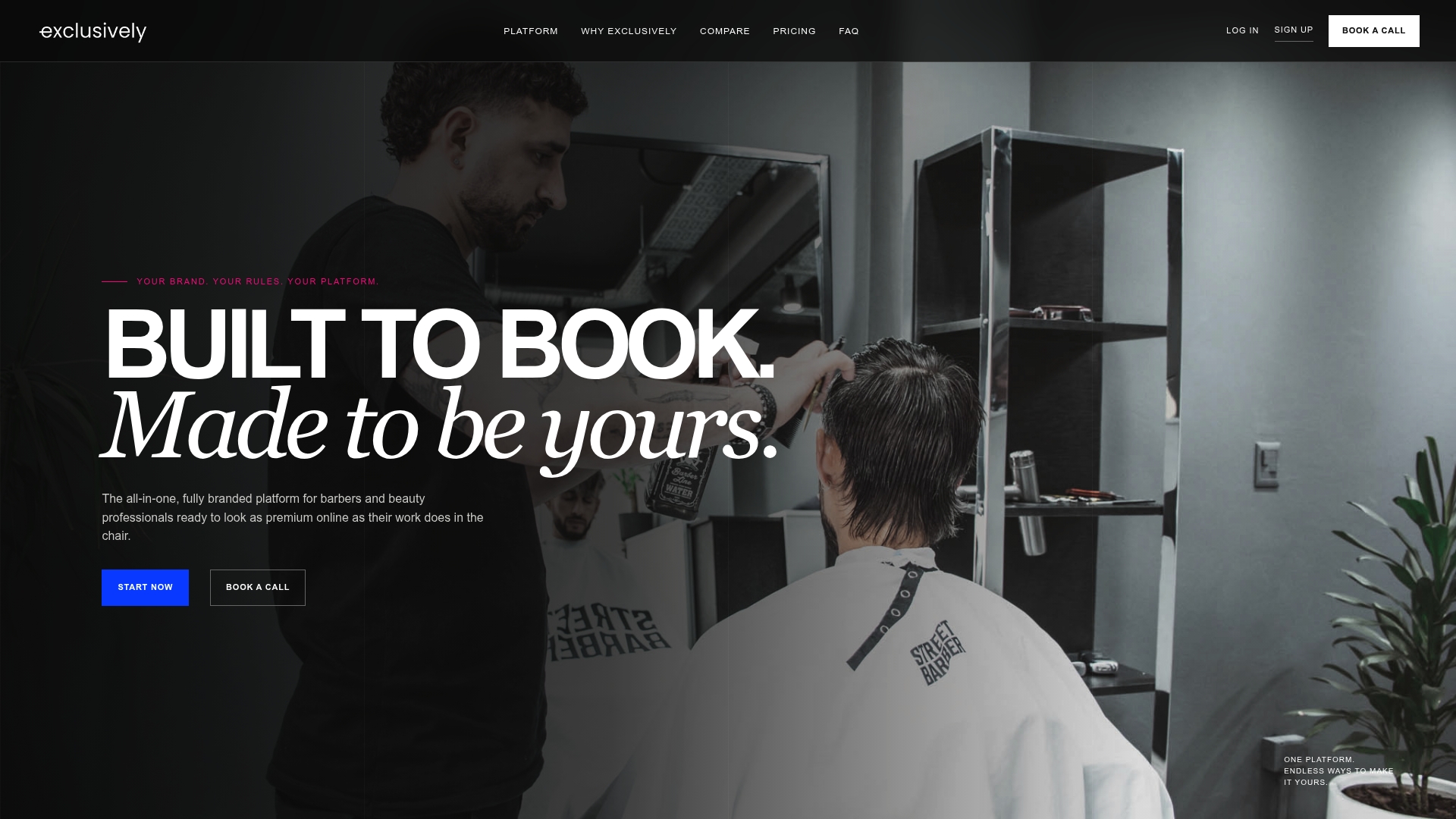
See the full plan details, look at how custom barbershop websites and branded mobile apps work, or book a call to talk through your setup. If you take card payments in the chair or at booking, our Square payments page explains how that fits in.
If your clients tap through from Instagram or a text, our guide to app deep links shows how to open booking straight in your app.
A one-page onboarding checklist
Print this for your station or share it with your team:
- Booking page shows services, prices, durations and policies.
- Confirmation and welcome message sent immediately.
- Pre-visit questionnaire sent; first-time color clients flagged for patch testing.
- Reminder sent 24 to 48 hours ahead.
- Greet at the door; consult away from the chair.
- Review history, goal, maintenance and the total price out loud.
- Perform the service; walk the result against the reference photos.
- Give a short written homecare plan.
- Offer two specific rebooking times before payment.
- Follow up within 48 hours; note the reason if they did not rebook.
FAQ
What is involved in onboarding a new salon client?
Onboarding covers the booking, a welcome message, an intake form, a consultation with an agreed price, the service with a homecare talk, rebooking at checkout and a follow-up within about 48 hours. The aim is a client who knows what to expect and a professional who knows the client’s history and goals.
What should a new client intake form include?
Contact details, the service they want, their service history, allergies, relevant health information and a consent signature. For color services, add patch-test status. Barbers can use a shorter version focused on skin and scalp sensitivities.
When should I rebook a new client?
At checkout, before they pay. Suggest a specific timeframe for the service and offer two times to choose between. Cut and color clients are often due around four to six weeks later, but adjust to the service and the person.
How do I explain prices to a new client without awkwardness?
Publish them on your booking page, then say the total out loud before you begin, including any add-ons that might apply. A client who has heard the number and agreed to it has no surprise at the register.
Sources
- The 90-Day Salon Client Journey Map, The Salon Business
- Example consultation, allergy alert and industry tests record card, NHBF
- National Hairdressers’ Federation code of practice, Trading Standards
- How to Build Client Loyalty Behind the Chair, Conde Professional
- Salon T-Shirt Ideas: Designs for Stylists, Barbers and Nail Techs