
Boost Rebookings in 3–6 Months: Salon Loyalty Program for Owners
Boost Rebookings in 3–6 Months: Salon Loyalty Program for Owners
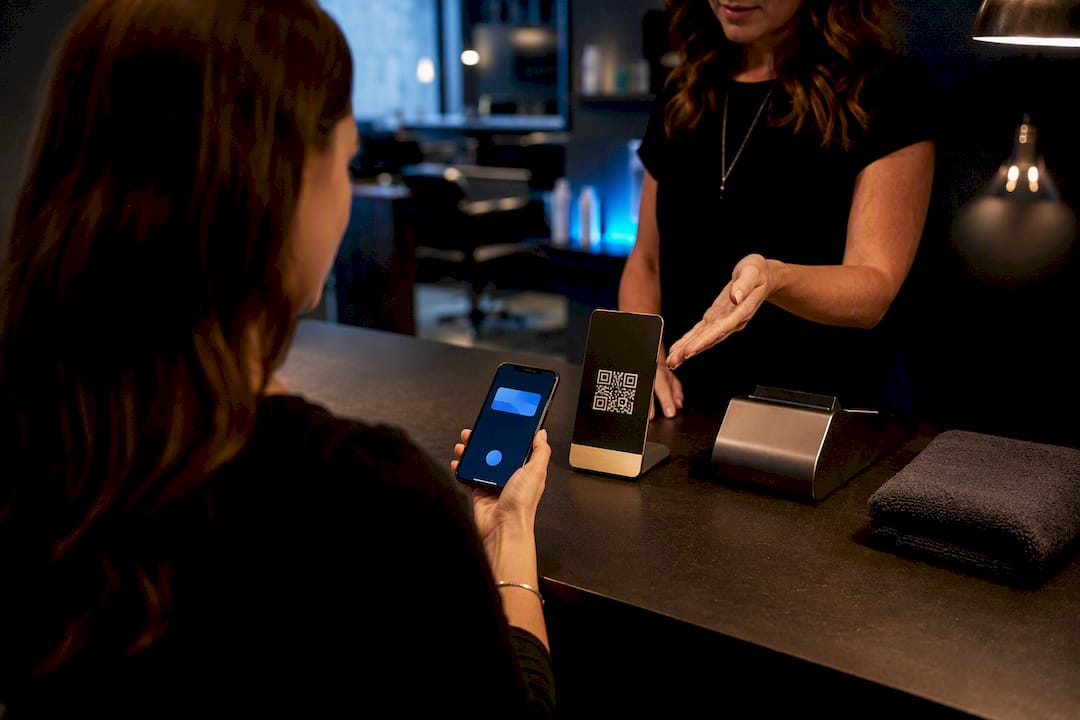
Start with a points-per-spend program that layers in a rebooking bonus and automated appointment reminders. This combination works because it rewards the services that already drive your revenue and shortens the gap between visits, which is where most salons lose clients. It’s the format Reviocard’s salon-specific research points to as the most practical starting structure, and it’s also the easiest version of a salon loyalty program to run with Getexclusively’s booking and payment tools already in place.
TL;DR:
- A rebooking bonus combined with automated appointment reminders significantly increases client retention and better tracks performance by stylist.
- Loyalty programs should match the salon’s size and volume, focusing on simple mechanics like points-per-spend for multipurpose salons or tiered VIP for high-ticket clients.
- Setting clear primary goals, such as visit frequency or retail attachment, ensures the program mechanics directly influence desired behavior.
- Automatic enrollment, quick data capture, and seamless integration with existing booking and payments systems are essential for sustainable program participation.
- Consistent marketing, quick staff scripts, and ongoing engagement are critical to prevent program fatigue and maintain long-term client interest.
Table of Contents
- What Types of Salon Loyalty Programs Work Best?
- How Do You Set Up a Salon Rewards Program?
- Real Salon Loyalty Program Templates You Can Copy
- What Software Features Do You Actually Need?
- How Do You Measure Loyalty Program ROI?
- How Exclusively Supports a Salon Rewards Program
- Why Do Loyalty Programs Fail, and How Do You Fix It?
- What Legal and Privacy Rules Apply to Salon Loyalty Programs?
- How Do You Keep a Loyalty Program Going After Launch?
- How Do You Personalize Rewards for Different Client Segments?
- The Real Priority Order for Building a Salon Loyalty Program
- Ready to Put This Into Practice?
- Sources
What Types of Salon Loyalty Programs Work Best?
Not every loyalty rewards program fits every chair count. A solo stylist running one book has different constraints than a six-chair salon juggling five commission structures, and the format you pick should match your volume, not just your ambition.
Here’s how the main formats break down:
- Points-per-spend: clients earn points tied to dollars spent, redeemable for discounts or free add-ons. Works well for salons with a mix of service price points, since higher-ticket visits earn proportionally more.
- Digital stamp/punch card: a fixed number of visits earns a reward. Simple to explain, easy to run on a phone, and a natural fit for solo operators or single-service shops (blowouts, brow bars).
- Referral programs: existing clients earn a reward when they bring in someone new. This tends to outperform paid ads on cost-per-acquisition for small salons.
- Tiered/VIP membership: clients unlock priority booking, early access to new services, or bigger discounts as they spend more. Fits high-ticket salons (color specialists, extensions, medical spas) where client lifetime value is already substantial.
- Paid membership/subscription: clients pay a flat monthly fee for a bundled service or discount tier. Works best where recurring maintenance services (blowouts, brow tinting) make the math predictable.
A handful of ideas travel well across almost every format. A rebooking bonus (extra points for booking the next appointment before leaving the chair) is the single highest-leverage tactic on this list. Per-stylist tracking turns loyalty data into a retention early-warning system: attribution by stylist shows you exactly which chair is bleeding repeat clients before it shows up in revenue. Double-stamp slow-day promotions fill Tuesday afternoons without discounting your peak Saturday slots. An interim reward at visit three keeps new clients from dropping off before the habit sticks, and a lapsed-client trigger (an automatic offer after 90 days of silence) recovers people before they’ve fully switched salons.
Set your reward thresholds to land around four to six months of typical visit frequency, not a full year. LoyaltyPass’s salon research found that goals reachable within that window changed client behavior; goals stretched out to twelve months mostly got ignored.
How Do You Set Up a Salon Rewards Program?
Before you touch software, decide the one number you’re trying to move. Is it visit frequency, average ticket, referral volume, or retail attach rate? The mechanic you choose should serve that number directly. A rebooking bonus targets visit frequency. A retail-redemption option targets attach rate. Trying to solve all four with one generic points system usually solves none of them well.
Here’s the rollout sequence that keeps a launch from stalling:
- Pick the primary metric and the mechanic that moves it (rebooking bonus for frequency, tiered VIP for high-ticket retention).
- Decide enrollment: automatic vs. opt-in. Automatic enrollment at checkout captures far more clients, but you still need explicit consent for marketing messages, which is a separate step (more on that below).
- Capture the right data at sign-up: phone or email, birth month for birthday bonuses, and which stylist the client is attributed to.
- Write staff scripts so the ask is consistent. Something as short as: “You just earned points toward your next visit. Want me to add your birthday so you get a free add-on that month?” takes under ten seconds, which matters more than it sounds like it should.
- Set automation triggers: a pre-book bonus prompt at checkout, a wallet-pass reminder three days before an expected rebooking window, and a win-back offer after 90 days of inactivity.
- Run a simple A/B test on the rebooking bonus itself. Split walk-out clients into two groups for a month. One gets the bonus offer, one doesn’t. Compare rebooking rates before rolling it out salon-wide.
LoyaltyPass’s operational research notes that every loyalty touchpoint needs to take under ten seconds at checkout or staff will quietly stop mentioning it. That single constraint should shape every script and automation trigger you build.
Pro Tip: Have your front-desk staff practice the sign-up script out loud before launch day. A script that reads fine on paper often stumbles the first few times it’s said to a real client, and those first fumbling attempts are exactly when new clients decide whether the program feels worth their time.

Real Salon Loyalty Program Templates You Can Copy
Three blueprints cover most salon situations, and each one has real-world precedent.
Blueprint A: Solo operator, low overhead. A QR-code digital stamp card, no app download required. Clients scan at checkout, earn a stamp, and get an interim reward at visit three (a free add-on, not a discount, so it doesn’t eat into your service price). This keeps enrollment friction near zero, which matters most when there’s no front-desk staff to manage a more complex system.
Blueprint B: Mid-size salon, multiple stylists. Points-per-spend (roughly one point per dollar), with a rebooking bonus worth 20 to 25 extra points, redeemable against both services and retail. Real reward pages like Gould’s Salon & Spa show this exact structure in production: automatic enrollment, points per dollar, prebooking bonuses, birthday bonuses, and referral rewards with no expiration date.
Blueprint C: High-end salon or medical spa. Tiered VIP membership, where crossing an annual spend threshold unlocks early booking access, complimentary touch-ups, or invitation-only events. This format leans on status and access more than discounts, which fits a clientele that isn’t especially price-sensitive.
Message templates worth stealing directly:
- Sign-up: “You’re enrolled. Every dollar earns a point, and booking your next visit before you leave earns you 25 bonus points.”
- Rebooking reminder: “You’re 4 points from your next reward. Book before [date] to lock in double points.”
- Referral invite: “Send a friend our way. You both get 50 points on their first visit.”
- Win-back: “We’ve missed you. Here’s 100 points on us for your next visit.”
A worked example: if a $150-average-ticket client redeems a $15 reward every fifth visit, that’s a 2% discount on lifetime spend. If the rebooking bonus increases their annual visits from four to five, the extra visit alone covers the reward cost several times over.
| Blueprint | Reward mechanic | Typical fit |
|---|---|---|
| A: QR digital stamp | Free add-on at visit 3 | Solo stylist, single-service shop |
| B: Points-per-spend | Rebooking bonus + retail redemption | Multi-chair salon |
| C: Tiered VIP | Early access, priority booking | High-ticket or medical spa |
What Software Features Do You Actually Need?
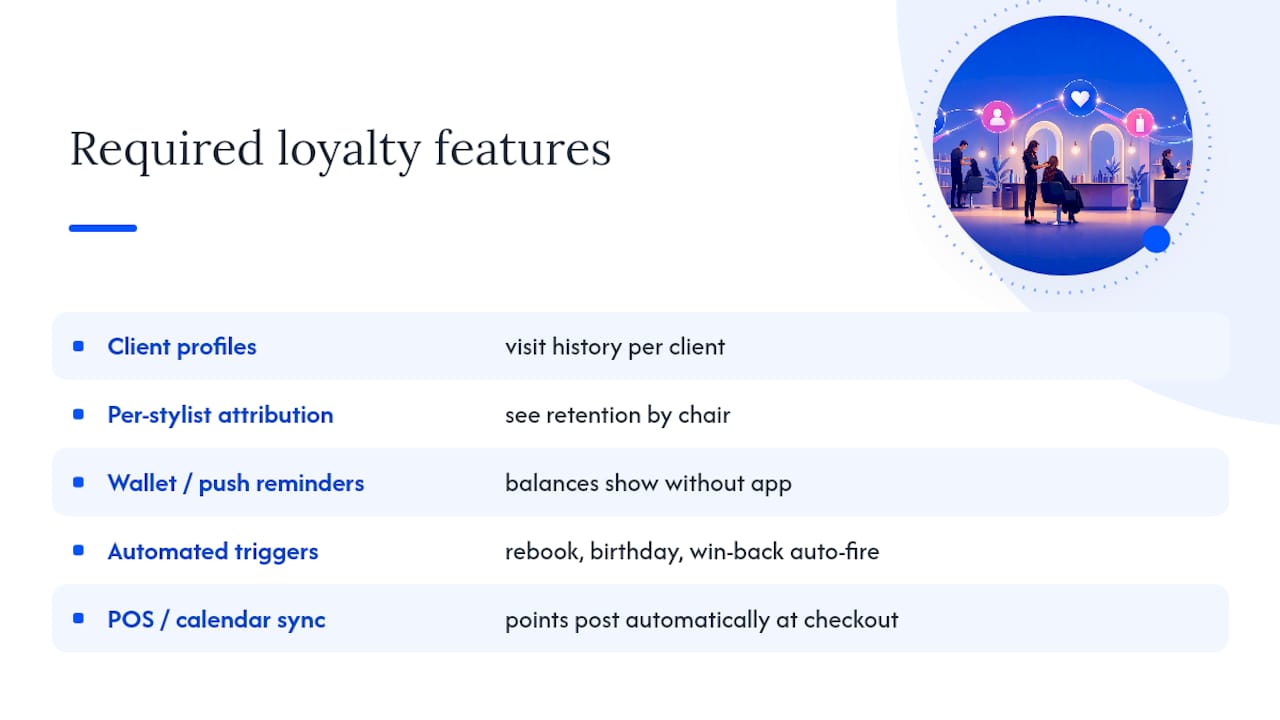
The feature list matters more than the brand name on the login screen. Before you sign anything, confirm the platform handles client profiles with visit history, per-stylist attribution so you can see retention by chair, and wallet-pass or push notification support so reward balances show up without a separate app open. Automated triggers (rebooking prompts, birthday bonuses, lapsed-client win-backs) need to fire without someone manually checking a spreadsheet, and the whole thing needs to sync with your point-of-sale or booking calendar so points post automatically at checkout.
Integration generally follows one of three patterns. POS-first systems tether loyalty to your existing payment terminal. Booking-platform-first systems tie rewards to appointment scheduling. Native-app systems, where booking, payments, and loyalty live inside one branded mobile experience, tend to have the least friction because the client never has to open a second app to check their balance.
Small salons without a dedicated front-desk system can still run a basic version with a paper punch card or a simple spreadsheet, but expect manual tracking to break down past a certain client volume. Shopify’s salon software guide recommends looking for automatic enrollment, per-client tracking, and checkout redemption as baseline requirements, regardless of vendor.
Before committing, test any vendor demo against a short checklist: Does it post points automatically at checkout? Does it attribute visits to individual stylists? Can it send a wallet-pass reminder without a client downloading a separate app? If the answer to any of those is “with a workaround,” expect adoption to lag.
How Do You Measure Loyalty Program ROI?
Track four numbers: visit frequency, average cycle length between visits, retention or churn rate, and average ticket including retail attach. These four tell you whether the program is changing behavior or just costing you margin on visits that would have happened anyway.
Salons without a loyalty program typically retain around 35% of first-visit clients, while loyalty program members visit roughly 40% more often, according to Bain’s research on customer loyalty value. Small retention gains routinely produce outsized profit swings because repeat clients cost far less to serve than new ones.
Run a before/after comparison over a defined window, ideally three to six months, since that’s long enough for most visit cycles to complete twice. Pick a baseline month before launch, then compare the same metrics three and six months out. A rough ROI example: if 200 active clients each add one extra visit a year at a $150 average ticket, that’s $30,000 in incremental annual revenue against a reward cost that typically runs 2 to 5% of redeemed spend. Re-evaluate quarterly for the first year, then twice a year once the numbers stabilize.
How Exclusively Supports a Salon Rewards Program
Every operational piece described above (per-stylist attribution, wallet reminders, automated triggers, checkout redemption) maps directly onto features salons already need for booking and payments, which is why building loyalty on top of your existing platform beats bolting on a separate app.
Getexclusively’s branded mobile apps put wallet-pass reminders and push notifications in front of clients without asking them to install a second tool. Membership management handles the recurring-payment side of a tiered or subscription model, and Square-integrated payments let redemption happen at checkout instead of through a separate loyalty terminal. Per-provider pricing controls allow each stylist’s rebooking bonuses and attribution data to stay tied to their own book, not a shared salon-wide pool.
Why Do Loyalty Programs Fail, and How Do You Fix It?
Low participation is the most common failure mode, and it’s almost always an enrollment-friction problem, not a reward-value problem. If signing up takes longer than the haircut, staff will stop asking. The fix is automatic enrollment at checkout with a single verbal prompt, not a form.
Fraud is a smaller risk than owners assume, but it happens: clients sharing punch cards, or staff manually adding points for friends. Digital tracking tied to a phone number or payment card closes most of this gap automatically, since points post to an account rather than a physical card anyone can hand off.
Customer fatigue shows up differently. It’s not that clients quit the program. It’s that they stop noticing it. A points balance that never changes visibly, or a reward threshold that feels permanently out of reach, fades into background noise. Refreshing the reward menu every few months, and surfacing the balance at the moment it matters (right before checkout, right before a rebooking decision), keeps it visible without requiring a full relaunch.
The last failure mode is staff disengagement. If your team doesn’t understand why the program exists or doesn’t get credit for enrollments, they mention it inconsistently or not at all. Tying enrollment numbers to a small staff incentive, even something informal, tends to fix this faster than any software feature.
What Legal and Privacy Rules Apply to Salon Loyalty Programs?
Collecting phone numbers, emails, and birth dates for a rewards program puts you squarely inside consumer data protection rules, and the requirements vary by where your clients live. If you serve clients in the European Union, GDPR requires explicit, separate consent for marketing communications, not just for the loyalty program itself. In the United States, state-level laws like the California Consumer Privacy Act give clients the right to know what data you hold and to request deletion.
Practically, that means two separate checkboxes at sign-up: one for joining the rewards program, another for receiving marketing texts or emails. Bundling them into a single “I agree” checkbox is a common shortcut that creates real exposure if a client complains. Keep a record of when and how consent was given, since “the client verbally agreed” doesn’t hold up if a regulator asks. Also confirm your text messaging complies with opt-in rules under the Telephone Consumer Protection Act, since automated appointment or rewards reminders sent by text count as marketing communications in most interpretations.
None of this needs a lawyer on retainer for a single-location salon, but it does mean choosing software that separates program enrollment consent from marketing consent by default, rather than assuming one covers the other.
How Do You Keep a Loyalty Program Going After Launch?
The launch week gets attention. Month four is where most programs quietly stop mattering, because the initial push fades and staff go back to old habits. Sustaining engagement means building reminders into your regular marketing calendar, not treating the program as a one-time announcement.
Seasonal tie-ins work well here: a double-points week around a slow month, a referral push before a holiday season when clients are already thinking about gifting a friend a service. Social proof matters too. Posting a client’s redeemed reward (with permission) does more for enrollment than another generic “join our rewards program” post.
Email and text remain the most direct channel, since a points balance update or an expiring bonus notice gets opened at a much higher rate than a general newsletter. Pair that with in-salon signage at the checkout desk, since a lot of clients forget they’re even enrolled until someone mentions their balance out loud.
The strongest long-term tactic is tying the program to your rebooking conversation specifically. Every time a stylist books the next appointment, mentioning the bonus points attached to that booking reinforces the habit loop the whole program is built on.
How Do You Personalize Rewards for Different Client Segments?
Not every client responds to the same offer, and treating a first-time visitor the same as a five-year regular wastes both budget and relevance. Segmenting clients by visit frequency, average ticket, and service type lets you target offers that actually match behavior.
New clients (fewer than three visits) respond best to the interim reward tactic covered earlier, since the goal is simply getting them past the drop-off point. Mid-tier regulars, who visit consistently but haven’t hit VIP spend, respond well to rebooking bonuses and referral incentives. High-value clients, especially those already spending on color, extensions, or multiple services per visit, respond better to access and status rewards (early booking, exclusive events) than to another discount, since price sensitivity usually isn’t their main barrier.
Lapsed clients need a different message entirely: a specific, time-limited win-back offer rather than a generic “we miss you” note, since a vague message rarely moves someone who’s already found another salon they’re comfortable with.
The Real Priority Order for Building a Salon Loyalty Program
Most loyalty advice buries the one thing that actually matters under a pile of feature lists and reward-tier diagrams. The priority order is enrollment friction first, reward structure second, and marketing polish a distant third. A salon with an ugly punch card that every client actually signs up for beats a salon with a polished tiered VIP system nobody remembers to mention at checkout.
Where conventional advice gets it backwards is in over-engineering the reward math before nailing the ten-second checkout moment. Owners spend hours debating whether a rebooking bonus should be 20 points or 25, then launch a system that takes ninety seconds to explain and dies within a month from staff fatigue.
If you’re building your first program, skip the tiered VIP structure entirely. Start with points-per-spend, a rebooking bonus, and automated reminders. Get that running cleanly for two full visit cycles before adding a second mechanic. The salons that get the most out of a beauty salon membership or rewards structure aren’t the ones with the cleverest math. They’re the ones where every staff member says the same eight words at checkout, every single time.
— Service
Ready to Put This Into Practice?
Everything covered above (rebooking bonuses, per-stylist attribution, wallet reminders, membership billing) needs a system that already knows your booking calendar and your payment flow, not a separate loyalty app bolted on top. Some platforms are built as one branded platform where your website, mobile app, booking system, and payments already talk to each other, so a rewards program doesn’t require a second login or a second vendor relationship.
That means the rebooking bonus your staff mentions at checkout, the wallet-pass reminder that lands on a client’s phone three days later, and the membership payment that renews automatically all run through the same system you’re already using to take appointments. If you’re evaluating what a branded setup actually costs before committing, check current plans and pricing and see which tier fits your chair count and feature needs.
Sources
- Salon Loyalty Program Ideas: 8 That Work (Reviocard)
- Salon Loyalty Program Ideas for 2026 (LoyaltyPass)
- Salon Loyalty Program: Ideas, Examples, and Software (Shopify)
- Gould’s Rewards — Ways to Earn Points