
Salon Owners: 2026 Pricing Strategy, One Week Fixes, App Publishing
Salon Owners: 2026 Pricing Strategy, One Week Fixes, App Publishing
Price from a calculated cost floor, add 20 to 25% target net margin, then layer in tiered staff rates and high-margin add-ons. That single move fixes most underpricing problems overnight. Round up to a clean menu number, revisit the math annually, and raise prices 5 to 8% a year instead of waiting three years and shocking clients with a jump. If you have booking software, use it to publish menu changes fast and charge for consults on complex color work.
TL;DR:
- Most salons undercharge by 15 to 25 percent on color services due to underestimating processing time and product waste.
- Setting prices based on the true hourly chair cost, then adding a target margin and rounding up, ensures consistent profitability.
- Implementing tiered pricing by stylist experience and “starting from” quotes for variable services helps optimize revenue and transparency.
- Regularly increasing prices by 5 to 8 percent annually, with clear communication, prevents long-term underpricing and client shock.
- Using a booking platform with per-provider pricing, add-on prompts, and integrated payments simplifies menu management and price testing.
Table of Contents
- Quick Checklist: Immediate Pricing Fixes to Run This Week
- The Salon Pricing Formula: Calculate Your Cost Floor and Service Price
- Structuring Your Menu: Tiers, “Starting From,” and Service Groupings
- Tactical Levers to Increase Average Ticket Without Alienating Clients
- When and How to Raise Prices: Signals, Cadence, and Client Communication
- Common Pricing Mistakes and How to Audit Your Menu
- How a Branded Booking Platform Helps Enforce and Experiment With Pricing
- A Concise, Honest Option: Using Exclusively to Publish and Test Price Changes
- Author Perspective: Pricing as a Long-Term Business Lever
- Sources
Quick Checklist: Immediate Pricing Fixes to Run This Week
You don’t need a consultant or a spreadsheet marathon to start fixing your salon pricing strategy. Four moves, done in order, will tell you exactly where you’re bleeding margin.
- Calculate hourly chair cost for one chair and three services. Pick your haircut, your most common color service, and one add-on. Run the numbers before touching anything else on your menu.
- Pull menus from 8 to 10 nearby salons. Don’t just check prices, check what’s included. A $65 color that excludes a gloss is not the same service as your $85 color that includes one.
- Add or reprice one high-margin add-on at checkout. A scalp treatment, gloss, or deep-conditioning add-on is often the fastest revenue lever you have, since add-ons typically carry retail-like margins between 50% and 70%.
- Set a firm date for your next small price increase and tell your team now. Waiting until you “feel ready” is how salons end up three years behind their real costs.
Do these four things and you’ll already know more about your true numbers than most salon owners ever calculate. The rest of this guide builds on exactly this foundation.
The Salon Pricing Formula: Calculate Your Cost Floor and Service Price
Every salon pricing strategy that actually protects your income starts with one number: your hourly chair cost. Skip this and you’re pricing by feel, which is how most owners end up subsidizing their business with their own labor.
The formula is straightforward. Hourly chair cost = (rent allocated per chair + payroll including payroll taxes + product cost + software and booking fees + insurance + your target owner salary) divided by billable hours per month. From there, service price = cost ÷ (1 − target margin). If a haircut costs you $28 in labor, product, and overhead, and you want a 25% margin, you divide $28 by 0.75. That’s $37.33, which rounds cleanly to $38 or $39.
Here’s what typically feeds into that cost side of the equation:
- Rent per chair: your monthly lease divided by number of working stations
- Payroll per service: stylist wage plus employer-side payroll tax, prorated to service time
- Product cost (COGS): actual color, developer, and treatment product used, not a guess
- Software and booking fees: your monthly platform cost divided across booked appointments
- Insurance and owner draw: liability coverage plus the salary you intend to actually pay yourself
Pro Tip: Round up, never down. A $128.20 calculated price rounds to $130, not $128 flat. Those few dollars across hundreds of monthly services add up to real annual revenue.
One insight worth sitting with: color services are where most salons lose the most money without knowing it. A recent analysis of salon pricing found that once owners actually run the formula on their color menu, they discover they’ve been undercharging by 15 to 25% relative to true product and labor cost. The gap comes from underestimating processing time and color waste, not from bad intentions.

Hair Salon Pro’s breakdown of the three pricing decisions frames this well: cost floor, real service time, and profit margin are three separate decisions, not one blended guess. Get the time wrong (forgetting shampoo, consultation, and cleanup minutes) and every downstream number is wrong too.
Structuring Your Menu: Tiers, “Starting From,” and Service Groupings
Once your cost floor is solid, the next decision is how to present prices so clients understand what they’re paying for and stylists have a career ladder to climb.
Tiered pricing by stylist level works when you have distinct experience bands on staff, junior, senior, and master, and want to both protect newer stylists from being underbooked and reward tenure. Tiered structures do double duty: they capture what clients are actually willing to pay for experience, and they give your staff a visible reason to stay and grow with you instead of job-hopping for a title bump.
For anything with real variability, corrective color, extensions, curly cuts, use “starting from” pricing rather than a flat number. This protects you from underquoting a two-hour correction at a 45-minute price, and it signals to clients that a consultation determines the final cost.
- Use flat pricing for standardized, low-variability services (blowouts, basic trims, single-process color)
- Use “starting from” pricing for anything where hair condition, length, or density changes the labor time
- Require a consultation, ideally a paid one, before quoting corrective or extension work
Pro Tip: Keep your core menu between 15 and 25 items. Beyond that, clients stop reading and just ask the front desk “what do you recommend,” which puts pricing pressure back on your staff instead of your menu doing the work.
Group services by category (cuts, color, treatments, add-ons) rather than alphabetically or by price. A scannable menu with clear tier labels sells your senior stylists’ expertise without your front desk having to explain the difference every single time.
Tactical Levers to Increase Average Ticket Without Alienating Clients
The fastest way to grow revenue isn’t raising your base prices, it’s giving clients more reasons to spend more per visit without feeling upsold.
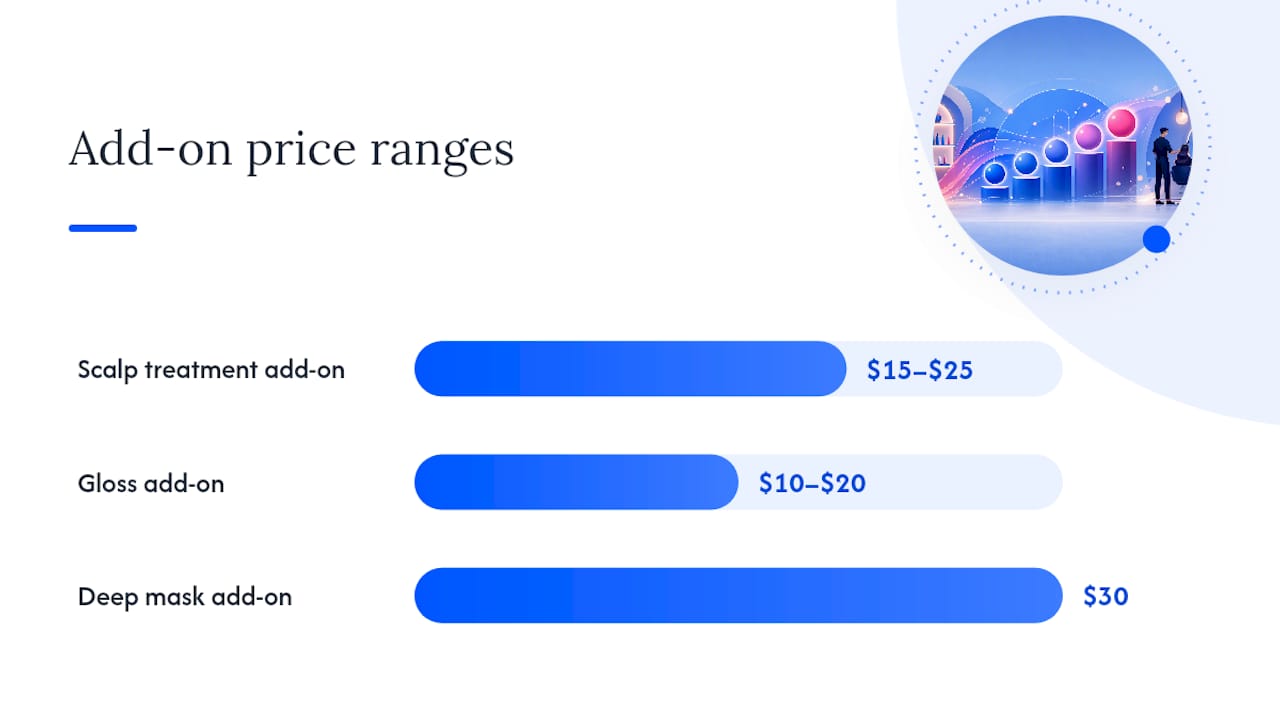
Add-ons are the cleanest lever you have. A $15 to $25 scalp treatment, a $10 to $20 gloss, or a $30 deep-conditioning mask typically carries far better margin than your core service, since the labor is already happening in the chair. Price these deliberately instead of tossing them in as a courtesy.
Charging for consultations on complex color work does two things at once: it protects your senior stylist’s time from window shoppers, and it filters for clients who are actually ready to commit. Crediting that consult fee toward the eventual service keeps the practice from feeling punitive, most salons in that price range run $50 to $100 consult fees for color correction work.
Demand-based pricing is underused in this industry but works exactly like airline seat pricing: your busiest stylists can charge more because their calendar proves the demand exists. Test it quietly first, on one stylist with a genuine three-week waitlist, before rolling it salon-wide.
- Price add-ons individually rather than bundling them invisibly into the base service
- Credit consult fees toward the booked service to keep the policy client-friendly
- Test demand pricing on your single busiest stylist before expanding it
- Add a master or anchor tier above your current top price to reframe what “expensive” means on your menu
That last point matters more than it sounds. Adding one master-tier stylist at a visibly higher price point doesn’t just capture revenue from clients who want the top experience, it makes your senior tier look like the reasonable middle option by comparison.
When and How to Raise Prices: Signals, Cadence, and Client Communication
Most salon owners raise prices too late and too dramatically, which is exactly backward.
The baseline cadence that keeps you ahead of costs without shocking clients is a 5 to 8% annual increase, according to pricing guidance built around 2026 benchmarks. If you’re catching up from years of underpricing, a larger one-time correction, done transparently, beats a slow bleed of small increases that never quite close the gap.
How you communicate the change matters as much as the number itself:
- Send a pre-notification email two to three weeks before the new prices take effect
- Give front-desk staff a short script: “Yes, prices are adjusting starting [date] to reflect [rising product costs / expanded services]”
- Post in-salon signage at least a week ahead so no client is surprised at checkout
- Stagger the rollout: raise prices for new clients first, or increase one service line before the full menu, rather than changing everything at once
Pro Tip: Never apologize for a price increase in writing. State the change, the date, and move on. Over-explaining reads as uncertainty, and clients respond to confidence, not justification.
Rollout sequencing research on salon pricing backs this staggered approach specifically because it gives you a chance to gauge reaction before your entire client base sees the new numbers at once.
Common Pricing Mistakes and How to Audit Your Menu
The mistakes that erode margin fastest are rarely dramatic. They’re small, repeated decisions that feel reasonable in the moment.
Copying a competitor’s price list without knowing their cost structure is the most common one. A salon down the street charging $45 for a cut might be in a cheaper lease, running a leaner payroll, or simply pricing themselves into a loss you can’t see from outside. Discounting to fill empty chairs trains your client base to wait for deals, and ignoring product COGS or your own owner salary in the pricing math means you’re often working for less than minimum wage on your busiest services.
Run this audit monthly:
- Recalculate three core services against the cost floor formula and compare to your current menu price
- Time actual chair minutes for a week, not your assumed service time, prep and cleanup included
- Verify your add-on margins are still accurate as product costs shift
- Model the cash impact of a proposed price change against last month’s real booking volume
Track average ticket size, chair utilization rate, COGS as a percentage of revenue, and booking lead time every month. These four numbers will tell you faster than any annual review whether your salon pricing strategy is actually working.
How a Branded Booking Platform Helps Enforce and Experiment With Pricing
Running this formula on paper is one thing. Actually rolling out tiered rates, add-on pricing, and consult fees across a full team is where most owners get stuck without the right tools.
The operational pieces you need are specific: per-provider pricing controls so each stylist’s tier reflects their actual rate, add-on upsells built into the checkout flow, consult-fee billing for color corrections, fast menu editing when you’re testing a price change, and reporting that actually shows utilization and average ticket instead of just appointment counts.
- Per-provider pricing so junior, senior, and master rates live on each stylist’s own profile
- Add-on prompts at booking and checkout, not an afterthought at the chair
- Consult-fee collection built into the payment flow
- Utilization and average-ticket reporting to know when a price change is working
Per-provider pricing controls on a booking platform let you make these changes stylist by stylist instead of an all-or-nothing menu overhaul. And when payments run through integrated processing like Square or Stripe, collecting a consult fee or an add-on charge takes one tap, not an awkward manual invoice.
A Concise, Honest Option: Using Exclusively to Publish and Test Price Changes
Everything in this guide, cost-floor math, tiered rates, add-ons, consult fees, only works if you can actually publish and adjust it fast without waiting on a developer or fighting a clunky admin panel.

A branded platform can give each stylist their own pricing profile on a branded website and mobile app, so a junior-to-senior tier change or a new add-on doesn’t mean rebuilding your whole menu. Payments run through integrated Square processing, which makes charging and crediting consult fees for color correction simple instead of a manual workaround. If you’re currently comparing platforms, see how the feature set stacks up against Booksy or against SQUIRE before deciding. And if client acquisition needs a boost to absorb a price increase smoothly, pairing your new pricing with salon SEO support keeps new bookings flowing while existing clients adjust. Check Exclusively’s pricing plans to see which tier fits your salon’s size and start publishing menu changes on your own timeline.
Author Perspective: Pricing as a Long-Term Business Lever
Pricing is the single highest-leverage decision a salon owner makes, higher than any marketing spend or new service launch, because it touches every dollar that comes through the door. Most owners set prices once and forget them for years. Treat it instead as an annual review: recalculate your cost floor, check utilization, and adjust deliberately. Track average ticket and chair utilization monthly, and the rest of the math takes care of itself.
— Service
Sources
- Average Salon Prices in 2026: A Complete Guide for Salons
- Salon Pricing Strategy: The Complete Guide for Salon Owners