
10 Minute Menu Fix: Paste Ready Salon Service Descriptions for Salons
10 Minute Menu Fix: Paste Ready Salon Service Descriptions for Salons
A great salon service description sells the outcome, not the task, and it does three things every time: names what the client walks out with, lists exactly what’s included, and flags where price depends on hair length, density, or condition. Get those three right and clients stop comparing you on price alone. The templates and rewrite steps below show you how.
TL;DR:
- Clearly state what clients will walk out with, including the result, specific inclusions, and price factors like hair length or condition.
- Cover all core service categories with consistent, outcome-focused descriptions and specify whether prices are fixed or vary by consultation.
- Use concise, outcome-driven language with sensory details for signature services to justify premium pricing and attract bookings.
- Incorporate transparent, variable pricing language upfront, and consistently display stylist tiers to avoid confusion and build trust.
- Write brief, mobile-friendly descriptions for online booking, emphasizing outcomes and straight-forward add-on suggestions to increase conversions.
Table of Contents
- What Makes Salon Service Descriptions Worth the Effort
- The Core Service Categories Your Menu Can’t Skip
- Copy-Ready Templates You Can Paste Into Your Menu Today
- Pricing Language That Prevents Awkward Checkout Conversations
- Writing Descriptions That Actually Convert
- Turning Add-Ons Into Natural Upgrades, Not Afterthoughts
- Your 10-Minute Menu Fix
- A Note From Service
- How Exclusively Helps You Publish Descriptions That Actually Sell
- Sources
What Makes Salon Service Descriptions Worth the Effort
A one-line menu item like “Haircut, $65” tells a client nothing except a number to compare against the salon down the street. Rewrite it as “Precision cut and style, tailored to your face shape and hair texture,” and you’ve given someone a reason that has nothing to do with price. That shift matters more than most owners think.
Well-crafted service menus let salons promote premium services and clarify what’s actually included, which pushes clients toward higher-value bookings instead of the cheapest option on the sheet. When a description does the selling before the client even calls, front-desk staff spend less time explaining and more time booking.
The pitfalls are predictable:
- Task-only labels (“Color, $80”) with zero mention of what type or what’s included
- Jargon that means nothing to a first-time client (“Balayage” with no plain-language translation)
- Missing inclusions, so clients assume a blowout or gloss is free when it’s an add-on
- No duration or maintenance note, leaving clients to guess how long they’ll be in the chair
Pro Tip: Pull up your current menu right now and read it as if you’re a new client who has never set foot in a salon. If a line raises a question you can’t answer from the text alone, rewrite it.
The Core Service Categories Your Menu Can’t Skip
Most salon menus fall into seven buckets, and each one needs a consistent set of fields so clients know what they’re paying for before they book. The Salon Business’s catalog of common services is a useful reference if you’re building a menu from scratch.
- Haircuts and styling — who it’s for (first-time, maintenance, event), what’s included (wash, consultation, blowout), typical duration
- Color services — single process, balayage, highlights, corrective work; almost always need “priced by consultation” language once you move past a single-process refresh
- Chemical and smoothing treatments — keratin, relaxers, perms; must state maintenance requirements and how long results last
- Extensions — method (tape-in, sew-in, fusion), removal policy, and a strong consultation disclaimer since pricing swings widely by volume
- Facials and skincare — goal (hydration, anti-aging, congestion), steps involved, skin types it suits
- Nail care — service type (gel, dip, extensions), duration, and whether nail art is included or an add-on
- Waxing — area, session length, and any prep or aftercare notes
Color correction, extensions, and any “restorative” hair treatment are the three categories where “priced by consultation” belongs almost every time. Nailing those seven categories down means an owner can audit an entire menu in about twenty minutes.
Copy-Ready Templates You Can Paste Into Your Menu Today
These are written to be edited, not copied word for word. Swap in your salon’s terminology, but keep the structure: outcome first, inclusions second, caveat last.
-
Signature haircut. “A precision cut built around your face shape, hair texture, and how much time you actually spend styling at home. Includes consultation, shampoo and conditioning treatment, cut, and blowout style. 45 to 60 minutes.”
-
Balayage / highlights. “Hand-painted color that grows out soft, with no harsh regrowth line. We custom-blend your tone in consultation, then finish with a gloss to lock in shine. Price varies by length and density; most first-time balayage sessions run two to three hours.”
-
Corrective color. “For color that’s gone wrong, faded unevenly, or needs a full reset. This is a multi-step process built around a strand test and consultation before we touch a drop of color. Priced by consultation only, since every correction is different.”
-
Keratin smoothing treatment. “Cuts frizz and blow-dry time by roughly half for up to three months, without a chemical straightening effect. Includes wash, application, and heat processing. Two to three hours depending on hair length and density.”
-
Facial (hydrating). “A cleanse, exfoliation, and custom mask built to pull moisture back into dry or dehydrated skin, finished with facial massage and SPF. Facials typically move through steaming, exfoliation, extractions when needed, and a personalized mask, so ask your esthetician which steps apply to your skin type.”
-
Manicure (gel). “A shape, cuticle clean-up, and gel polish that holds shine and resists chipping for two to three weeks. 30 to 40 minutes. Nail art priced separately, starting at a per-nail rate posted at the front desk.”
-
Extensions (tape-in). “Add length and volume using tape-in wefts matched to your natural color and cut blended into your existing hair. Priced by consultation based on desired length and fullness; most full applications take two to three hours.”
One more thing worth doing: pick a single signature service and write it with sensory, experience-driven language instead of a clinical list of steps. Something like, “Step out of the shampoo bowl into a scalp massage that runs longer than most salons bother with, then leave with a blowout that actually survives the drive home,” does more to justify a premium price than any bullet list of technical steps. Save that tone for one or two flagship services. Use it everywhere and it starts to read like filler.
On jargon: technical terms like “single process,” “toner,” or “gloss” aren’t wrong to use, but pairing them with a plain-language outcome reduces confusion at booking and cuts down on the “wait, what does that mean?” calls to your front desk.
Pricing Language That Prevents Awkward Checkout Conversations
Nothing damages trust faster than a client expecting to pay $90 and getting handed a bill for $180 because their hair was longer or more color-heavy than the base price assumed. The fix isn’t lowering prices. It’s telling clients upfront that price flexes with specific, named factors.
Standard variable-pricing phrasing looks like this:
- “Starting at $X. Final price depends on hair length, density, and amount of color applied.”
- “Base price covers up to shoulder-length hair. Below-shoulder or extra-thick hair may incur an additional fee, quoted at consultation.”
- “Priced by consultation. We’ll give you an exact quote before any color touches your hair.”
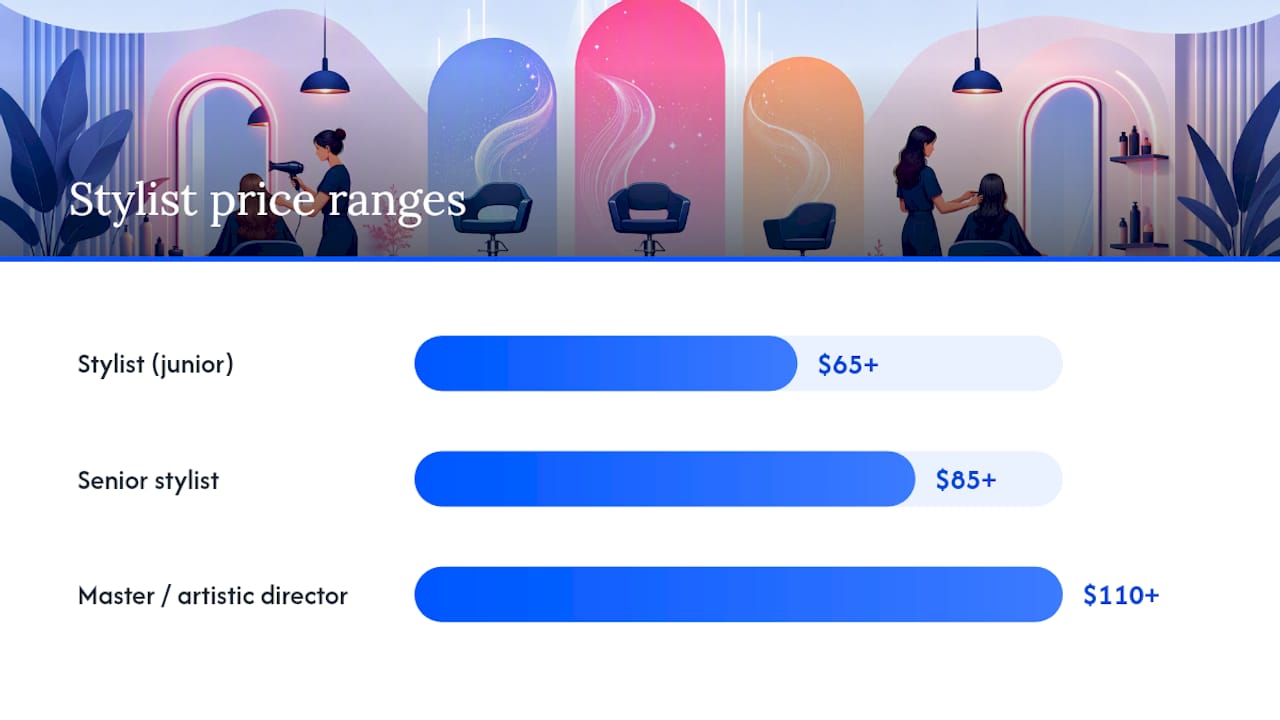
Stylist tiers deserve the same treatment. If your salon runs junior stylists, senior stylists, and a master or artistic director, list each tier with its own price range rather than burying the difference in fine print. Something as simple as “Stylist: $65+ / Senior Stylist: $85+ / Master Stylist: $110+” tells clients exactly what they’re choosing and why the range exists. Real salon menus often handle this by listing stylist level directly next to the service, which keeps the pricing conversation transparent before anyone sits in the chair.
Pro Tip: Put your consultation disclaimer in the same font size and placement across every service that needs one. Clients who see it consistently trust it. Clients who see it buried once and missing elsewhere assume it’s a loophole.
Writing Descriptions That Actually Convert
Length and placement matter as much as the words themselves. A description that reads beautifully on your website but runs six lines in a booking widget just gets cut off, so write for the shortest surface first.
For most booking platforms, aim for one to two sentences, roughly 15 to 25 words, for the primary description, with a longer version reserved for your full website menu. Lead with the outcome, follow with inclusions, and put any pricing caveat last so it doesn’t interrupt the sell.
On search visibility: work the service name plus a location modifier naturally into your website copy (“balayage highlights in [your city]”) rather than into the booking widget itself, where clients are already committed to booking and don’t need to read search-friendly phrasing. Stacking keywords into client-facing menu text just makes it harder to read.
Booking microcopy does a lot of quiet work:
- CTA wording: “Book your cut” outperforms a flat “Book now” because it names the service
- Add-on prompts: “Add a scalp treatment for smoother, healthier-feeling hair” beats a bare checkbox labeled “Scalp Treatment, +$15”
- Technical term explainers: a one-line tooltip or subtext under “Brazilian Blowout” explaining it reduces frizz for up to twelve weeks answers the question before a client has to ask it
Pro Tip: Read your booking flow out loud on your phone, not your laptop. Most clients book from mobile, and copy that feels fine on a desktop screen often runs long and clunky on a five-inch display.
Turning Add-Ons Into Natural Upgrades, Not Afterthoughts
The add-ons that convert best tend to have a visible, immediate payoff: a gloss that adds shine right there in the mirror, a bond-builder that a client can feel in smoother texture, or thermal styling that finishes the look before they leave the chair. Add-ons with delayed or invisible benefits are a harder sell.
Placement matters as much as the add-on itself:
- Use inline phrasing directly in the service description for high-margin, near-universal add-ons (“finished with an Olaplex bond treatment”)
- Use checkbox upsells during booking for optional, situational add-ons a client might skip (deep conditioning, nail art)
- Bundle language should frame the add-on as a complement, not an extra charge: “Complete your color with a gloss that locks in tone and shine” reads very differently than “Gloss: +$25”
Your 10-Minute Menu Fix
If you only have ten minutes today, work through this in order:
- Swap every task-only label (“Haircut”) for an outcome phrase (“Precision cut tailored to your face shape”)
- Add a duration estimate to every service missing one
- Add a one-line pricing caveat to color, extensions, and any chemical treatment
- Rewrite your top three CTA buttons to name the service, not just say “Book Now”
- Pick one signature service and give it sensory, experience-driven language
- Add a plain-language explainer under any term a first-time client wouldn’t recognize
Six templates you can paste in right now: “Cut & style, tailored to you, 45 min.” / “Color refresh, priced by consultation.” / “Gel manicure, chip-resistant shine, 30 min.” / “Hydrating facial, custom to your skin, 50 min.” / “Keratin smoothing, frizz-free for months.” / “Tape-in extensions, priced by consultation.”
Change one section of your menu, leave the rest as-is, and track average ticket for two to three weeks before rewriting everything at once. That comparison is the only way you’ll know which language actually moved bookings.
A Note From Service
We rewrote a single haircut description on a test menu, from “Haircut, $65” to a two-sentence outcome-and-inclusion version, and watched average ticket on that line item climb within a month. That’s one salon, one service. Try it on your highest-volume booking, track the number yourself, and see what your own clients respond to.
— Service
How Exclusively Helps You Publish Descriptions That Actually Sell
Rewriting your menu only pays off if the platform behind it lets you control every field: outcome language, inclusions, duration, and stylist-tier pricing, without waiting on a developer. Exclusively gives barbers and beauty professionals a custom branded website where every service description lives exactly as you write it, plus a booking system with editable service fields so you can test one rewritten description against the old version without touching code.
Add-on checkboxes sit right in the booking flow, stylist-level pricing displays clearly instead of getting buried in fine print, and payments run through integrated Square processing so clients see the final price before they ever sit in the chair. Everything is under your own brand, not a generic third-party directory. If you’re ready to see what that looks like for your business, check the pricing plans and start testing your rewritten menu this week.
Sources
- What is a facial? — Cleveland Clinic
- Types of facials, benefits and what to know before trying them — Everyday Health
- 47 Popular Hair Salon Services (Menu & Price List) — The Salon Business