
Salon Owners: 3 DOL Tipping Policy Steps, POS to Payroll Fixes
Salon Owners: 3 DOL Tipping Policy Steps, POS to Payroll Fixes

A compliant salon tipping policy must do three things without exception: it must forbid the owner or any manager from keeping employee tips, it must state plainly whether the salon takes a tip credit and how that limits who can share in a pool, and it must guarantee that every tip, whether paid in cash, by card, or through an app, gets logged and paid out by the regular payday.
TL;DR:
- Only employees who habitually and regularly receive tips can share in a tip pool when a salon takes a tip credit, while full-wage salons can include non-tipped staff.
- Tips must be distributed no later than the regular payday for the week they are earned, regardless of whether paid in cash, card, or app, to comply with federal law.
- Software systems need to accurately attach each tip to the specific employee and shift; app-based tips must be reported and logged similarly to cash tips.
- Including tips from mandatory service charges in the payroll as wages requires proper recordkeeping, as these are not considered tips under law.
- A comprehensive tipping policy should explicitly state tip retention rules, pooling eligibility, reporting procedures, and distribution schedules, and should be signed and enforced formally.
Table of Contents
- Salon Tipping Policy Checklist for This Week
- What Federal Law Actually Requires of Salon Owners
- How to Build Your Tipping Policy Step by Step
- Setting Up POS, Booking, and Payroll to Catch Every Tip
- A Tipping Policy Template You Can Adapt Today
- Auditing and Resolving Tip Disputes Before They Escalate
- What Owners Get Wrong About Salon Tipping
- Simplify Tip Tracking With an Integrated Platform
- Sources
Salon Tipping Policy Checklist for This Week
You don’t need a lawyer on retainer to close most of your exposure. Start with the highest-risk gaps and work down.
- Draft a written tipping policy and get owner or manager sign-off on the final version.
- Decide your pooling structure and make sure it matches your tip-credit status, not the other way around.
- Configure your POS and booking software to attach every tip to the employee and shift that earned it.
- Set a fixed distribution cadence tied to your payroll run, not to whenever someone gets around to counting the jar.
- Train every employee on how to report app-based tips (Venmo, CashApp) at the end of each shift.
Pro Tip: Run a “tip trace” test before you publish anything: take one card tip, one cash tip, and one app tip from a single shift and follow each through your POS, your payroll export, and your bank deposit. If any of the three goes dark before it hits a paycheck, your policy has a hole your staff will find before an auditor does.
What Federal Law Actually Requires of Salon Owners
The Fair Labor Standards Act sets the floor, and it’s stricter than most salon owners assume. Under the Wage and Hour Division’s final rule on tip regulations, employers can never keep employee tips for themselves, and managers or supervisors cannot draw from a tip pool, with one exception: a manager keeps tips they personally receive for services they personally perform, such as a shop owner who still cuts hair three days a week.
Tip pooling splits into two tracks, and which one applies to your salon depends entirely on whether you take a tip credit against minimum wage:
- Traditional pools apply when you take a tip credit. Only employees who customarily and regularly receive tips, stylists, colorists, estheticians, can share in the pool.
- Nontraditional pools apply when you pay full minimum wage with no tip credit. You may then include front-desk staff, shampoo assistants, or other non-tipped roles, per DOL Fact Sheet #15.
Timing matters as much as structure. Once your salon collects tips to redistribute, whether that’s a shared credit card batch or a communal jar, 29 CFR § 531.54 requires you to distribute them no later than the regular payday for that workweek. If the exact tip amount isn’t known when payroll runs, you pay it out as soon as practicable afterward. Sitting on tips for two or three pay cycles “to make the math easier” is not a gray area. It’s treated the same as an employer keeping tips outright.
One more distinction owners routinely miss: a mandatory service charge added to a bill is legally the salon’s revenue, not a tip, and gets treated as wages, not gratuities, even if you later share part of it with staff. If you’re claiming a tip credit anywhere in your business, you also need to keep records of employee tip declarations and hours worked in tipped versus non-tipped duties, since a stylist who spends part of a shift folding towels can’t have that time counted against the tip credit the same way.
How to Build Your Tipping Policy Step by Step
A policy that lives only in your head, or in a group text from three years ago, is not a policy. Here’s the sequence that turns it into something you can defend.
- Commit to your tip-credit position first. Everything else, pooling eligibility, minimum wage math, recordkeeping, flows from this one decision. Write it down explicitly: “This salon does / does not take a tip credit.”
- Choose your pooling formula. Decide the contribution percentage or flat structure, who’s eligible based on your tip-credit answer above, and how often the pool splits.
- Build the reporting process. Require staff to log cash tips and third-party app tips before they leave each shift, with a signed daily tip report.
- Lock in payroll timing. Tips get folded into the regular payday. If a card batch or app tip isn’t reconciled yet, it goes out as soon as it is.
- Train on it, then put it in the handbook. New hires sign an acknowledgment during onboarding, not six months in when a dispute already happened.
A few things trip up otherwise careful owners:
- Verbal “we split it evenly” arrangements don’t hold up once someone disputes a payout.
- A policy that never mentions app tips guarantees underreporting, because staff assume cash-app money is theirs to skip.
- Skipping the signed acknowledgment step means you have no proof staff ever agreed to the terms.
Setting Up POS, Booking, and Payroll to Catch Every Tip
The biggest source of tip disputes isn’t bad intentions. It’s software that doesn’t talk to itself. Your POS, your booking platform, and your payroll system need to agree on who earned what, or you’re reconciling by memory.
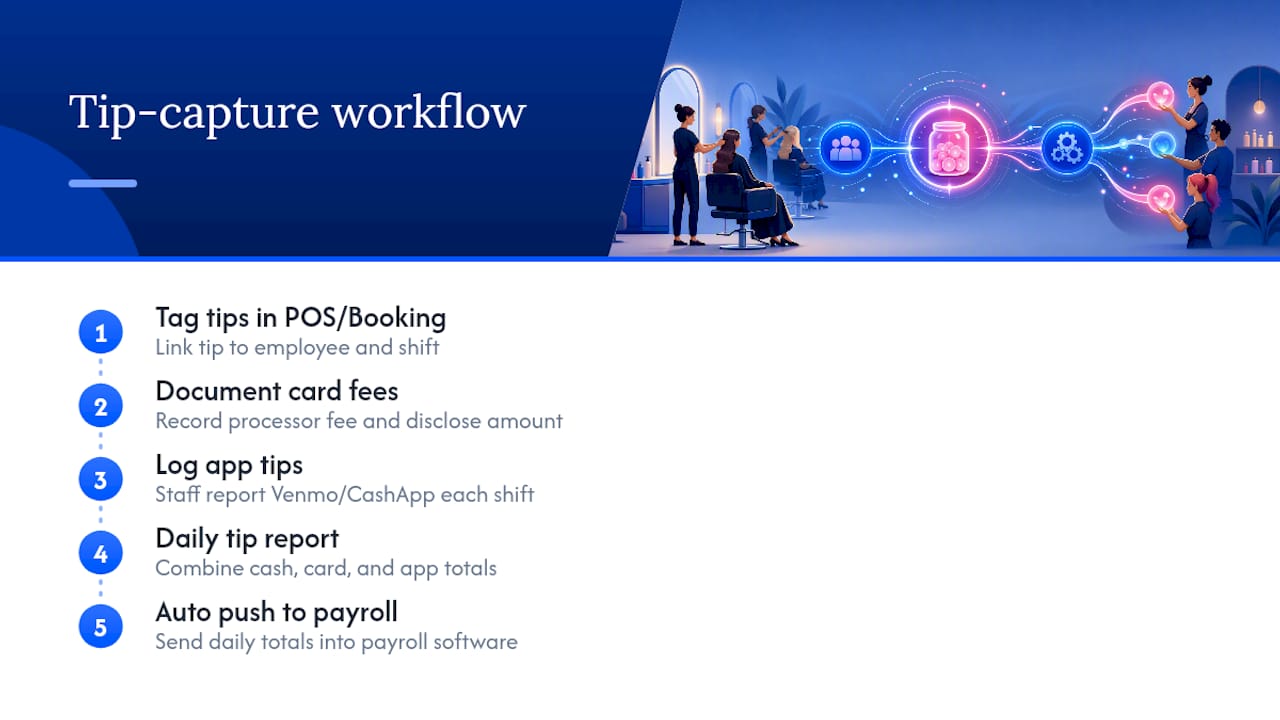
Start by configuring your POS and booking software so every tip, cash, card, or digital, gets tagged to the specific employee and the shift they worked, not just to “the salon” as a lump sum. That single setting eliminates most of the manual guesswork owners do at month-end.
Card tips introduce a wrinkle: processing fees. If your salon deducts a portion of the card processing fee from the tip before paying it to the stylist, that deduction needs to be documented and disclosed, and it has to reflect the actual cost of processing, not a padded number. Reference your processor’s own terms, whether that’s Square’s payment processing terms or Stripe’s processing terms, so staff can see exactly how the math works.
App-based tips through Venmo or CashApp are trickier because they bypass your POS entirely. Require staff to report those tips at shift end and log them in the same daily tip report as cash, since a tip for a service performed at your salon counts as salon income for tax and wage purposes no matter which app moved the money.
Pro Tip: Push tip totals into your payroll software automatically rather than retyping them. Manual re-entry is where cash tips quietly vanish and where card tips get double-counted, and both mistakes look identical to an auditor.
A Tipping Policy Template You Can Adapt Today
Every written policy needs the same backbone. Here’s the structure, with sample language you can drop into your handbook.
- Purpose and scope: “This policy governs all tips received by employees for services performed at [Salon Name], including cash, card, and third-party app payments.”
- Manager exclusion: “Owners, managers, and supervisors do not participate in the tip pool, except for tips received directly for services they personally perform.”
- Pooling rules: “Tips are pooled among [list eligible roles] and distributed according to [formula], consistent with the salon’s tip-credit status.”
- Reporting: “Employees must report all cash and app-based tips (Venmo, CashApp, etc.) on a signed daily tip report before the end of each shift.”
- Distribution timing: “All collected tips are distributed no later than the regular payday for the workweek in which they were earned.”
- Audit rights: “The salon reserves the right to review tip reports, POS records, and payroll entries for accuracy.”
Auditing and Resolving Tip Disputes Before They Escalate
Run a monthly reconciliation comparing service revenue against reported tips and credit card tip totals against what actually landed in payroll. Keep an “audit box,” physical or digital, with signed daily tip reports, payroll run sheets, and signed policy acknowledgments.
- When a dispute arises, pull the audit box first and set an investigation deadline, ideally within a few business days.
- Document every step, including interim pay adjustments if the error is clear.
- Escalate to a payroll specialist or employment counsel if the discrepancy involves tip-credit calculations or repeated underreporting.
Pro Tip: A repeatable reconciliation habit, daily tip reports checked against POS output checked against payroll, catches unreported cash or app tips months before an audit ever would.
What Owners Get Wrong About Salon Tipping
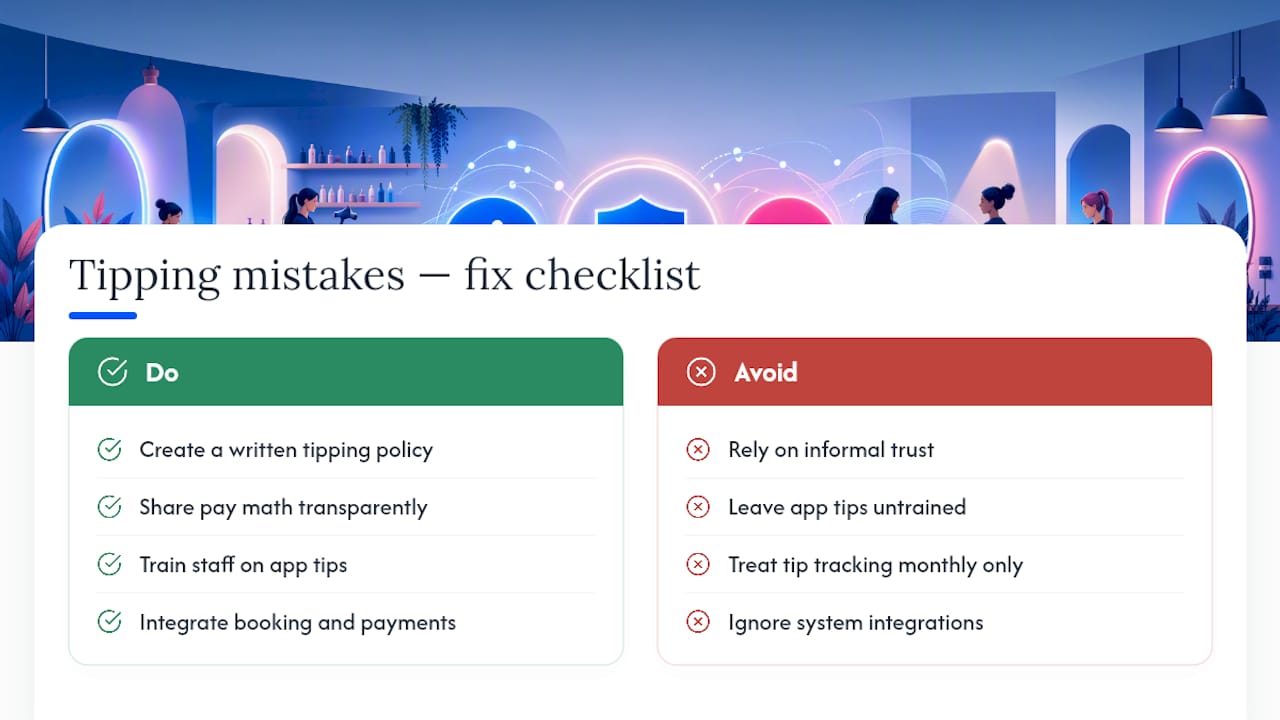
The biggest mistake I see isn’t a bad policy. It’s no policy, propped up by trust that erodes the moment a new hire questions the math. Transparency isn’t a soft benefit; it’s the thing that keeps your best stylist from Googling their rights after a confusing paycheck.
App tips are where most owners get burned first, because nobody trains for them until a dispute forces the conversation. And once your booking and payment systems talk to each other, tip tracking stops being a monthly headache and starts being a two-minute report.
— Service
Simplify Tip Tracking With an Integrated Platform
A written policy only works if your software can enforce it. Getexclusively ties your branded booking site, mobile app, and payment processing together so every tip gets tagged to the employee and shift that earned it, not buried in a lump-sum batch you have to untangle by hand at month-end.

The platform runs on Square payment processing, giving you the same fee transparency your policy needs to document, plus provider-level pricing and availability so each stylist’s earnings, tips included, stay attached to their own schedule. Owners switching from spreadsheet-and-jar systems often start with the booking help videos to see how tip data flows from appointment to payout before committing to anything. If you’re ready to see what a fully branded booking and payments setup looks like for your salon, check Exclusively’s pricing and get your appointment booking live this week.
Sources
- Wage and Hour Division: Tip Regulations under the Fair Labor Standards Act — final rule
- 29 CFR § 531.54 - Tip pooling. | Legal Information Institute