
Salon Owners: Boost Tickets 10–30% With 5 Fast Add Ons
Salon Owners: Boost Tickets 10–30% With 5 Fast Add Ons
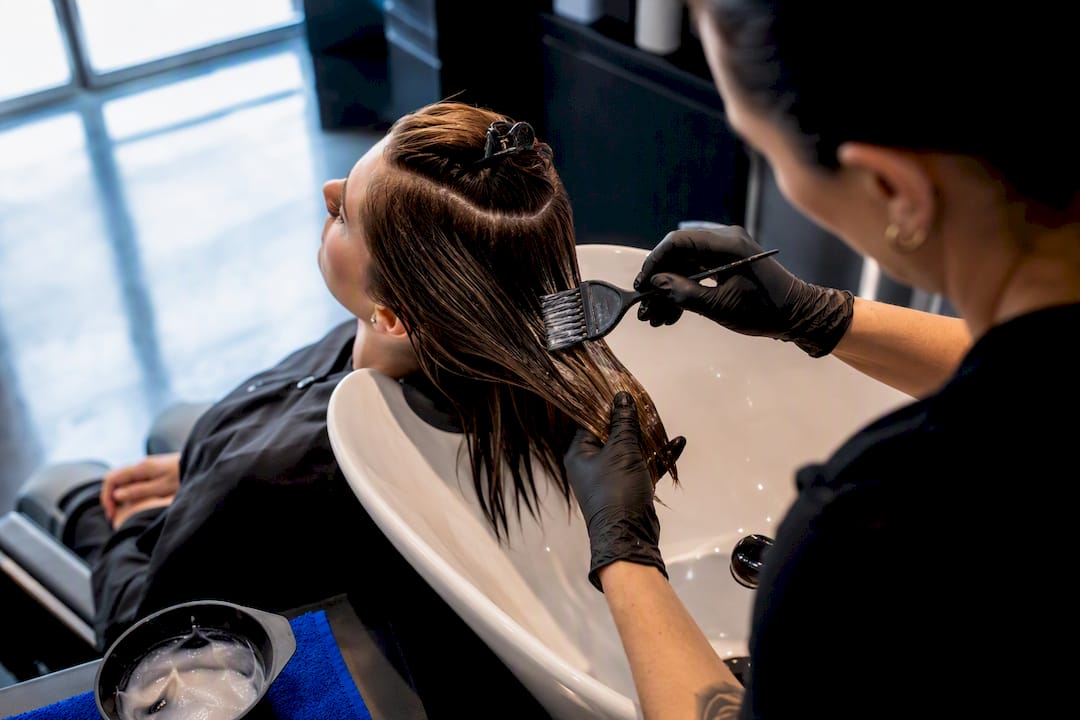
Add bond treatments, glosses, deep conditioning, scalp massage, and express color to your service menu now, since these five upsells can lift ticket totals 10 to 30 percent without extending your appointment slots. Pick 3 to 5 of them, train every stylist on the same script by next week, and add checkboxes to your booking flow before you touch anything else.
TL;DR:
- Bond treatments and glosses generate the highest profit per minute because they layer onto processing time already billed for, each adding only a few minutes.
- Choose upsells that fit client needs, add minimal chair time, and can be consistently delivered by all stylists to maximize revenue and maintain quality.
- Implement booking system checkboxes and automated messages to pre-sell add-ons, increasing the likelihood of client acceptance without sounding pushy.
- Price most add-ons between 15 and 45 dollars to reinforce value, and bundle services to boost perceived value and encourage higher ticket totals.
- Track key metrics weekly, such as attachment rate and rebooking likelihood, to refine upsell scripts and staff incentives for sustained revenue growth.
Table of Contents
- What Are the Best Salon Upsell Ideas by Service Category?
- How Do You Choose Your First 3 to 5 Upsells?
- When and How Should You Offer Add-Ons Without Sounding Pushy?
- Can Your Booking System Sell for You?
- How Do You Turn Retail Into an Effortless Upsell?
- What Should You Charge, and How Should You Bundle?
- How Do You Roll Out Upsells and Track What’s Working?
- How Should You Handle a Client Who Says No?
- How Do You Motivate Staff to Sell Add-Ons Consistently?
- What Do Real Salon Upsell Wins Look Like?
- Where Do Upselling Ethics Come Into Play?
- Owner Perspective: Revenue With Integrity
- How Can a Branded Booking Platform Reduce Upsell Friction?
- Sources
What Are the Best Salon Upsell Ideas by Service Category?
The upsells that actually move revenue share one trait: they either process while you’re doing something else, or they take under 15 minutes to deliver. Here’s how the categories break down.
Hair services
- Bond treatments (Olaplex-style): adds 5 to 10 minutes during color processing, product cost around $2 to $4, sells for $25 to $45.
- Gloss or toner: adds 10 to 20 minutes, product cost roughly $3 to $6, sells for $20 to $40. Modern Salon flags these express services as visible results in under 30 minutes.
- Deep conditioning masks: adds 5 to 15 minutes under a processing cap, sells for $15 to $35.
- Scalp massage: adds 5 to 10 minutes, near-zero product cost, sells for $10 to $20 and drives rebooking almost as much as revenue.
Facial and skin add-ons
- Express hydrating masks during a blowout wait: 10 minutes, $15 to $25.
- LED light add-on during a facial: minimal labor, $20 to $30.
Nail services
- Nail art accents (an accent nail, chrome tips, simple hand-painted design): 5 to 15 minutes, $5 to $20 per hand.
- Paraffin dip: 10 minutes, low cost, $10 to $15.
Retail
- Travel-size shampoo, conditioner, or styling product sold immediately after in-service use, margin typically 40 to 50 percent per unit.
Bond treatments and glosses lead the pack on profit per minute because they layer onto processing time you’re already billing for. Scalp massage wins on client delight even though the dollar amount is small.
How Do You Choose Your First 3 to 5 Upsells?
Run every candidate add-on through the same five-question filter before it goes on your menu.
- Does it fit what most of your clients already book? A color-heavy salon should lead with gloss and bond treatments, not nail art.
- How much extra chair time does it add? Anything over 15 minutes needs its own appointment slot, not an add-on label.
- What’s the product cost per use? Divide cost by sale price. If margin drops below 60 percent, reconsider the price or the product.
- What’s the revenue per minute? A $30 add-on that takes 5 minutes beats a $40 add-on that takes 25.
- Can every stylist deliver it consistently? An upsell that only your best technician can execute isn’t ready for the whole floor.
Starter sets by salon type: a color-focused salon should pilot gloss, bond treatment, and deep conditioning. A men’s barbershop does better with scalp massage, beard conditioning, and a hot towel upgrade. A full-service salon can combine gloss, bond treatment, and one retail take-home per visit.
Pro Tip: Don’t launch more than five add-ons at once. Staff can’t sell what they can’t remember, and clients tune out a menu that reads like a diner placemat.
When and How Should You Offer Add-Ons Without Sounding Pushy?
Five moments matter more than the rest: the consultation, while shampooing, mid-service, the booking confirmation message, and checkout. Miss the consultation and you’ve lost your best window, because that’s when a client volunteers the problem you’re about to solve.
The highest-converting language follows a three-part formula: diagnose, recommend, then state time and price in the same breath. HairSalonPro’s research backs this pattern because it reads as advisory instead of transactional.
- Color client: “Your ends look a little porous from the last lift. A bond treatment during processing runs $35 and adds about 10 minutes.”
- Cut client: “I’m noticing some dryness at the crown. A 10-minute deep conditioning mask is $20 and we can do it while you’re under the dryer.”
- Men’s service: “Your beard’s pretty coarse today. Want a hot towel and conditioning treatment? It’s $15 and adds five minutes.”
- Retail moment: “This is the mask I just used on you. A travel size is $18 if you want to keep the results going.”
Avoid two habits that kill trust fast: pressure phrases like “you really should” or “everyone gets this,” and stacking three offers on one client in one visit. One well-timed recommendation beats three rushed ones.
Before launch, run a 15-minute role-play with your team. Have each stylist practice the script out loud on a coworker, then swap and critique delivery, not just wording.
Can Your Booking System Sell for You?
Your booking flow and checkout screen do a lot of the selling before a client ever sits in the chair.
- Add-on checkboxes at booking: a client selecting a haircut sees an optional gloss checkbox with price and added time listed. The small friction of a checkbox actually increases intent, because the client made an active choice rather than being asked cold in the chair.
- Confirmation message priming: a text or email the day before that mentions “ask your stylist about our scalp treatment” primes acceptance before the appointment starts.
- Front-desk and POS prompts: a checkout screen that surfaces “add a travel-size product?” catches clients who skipped the in-chair offer.
- Automated nudges: branded mobile apps can push a reminder about add-ons tied to a client’s service history, which removes the burden from a busy front desk.
None of this replaces the stylist’s recommendation. It just means the client has already heard about the option twice by the time they’re in the chair.
How Do You Turn Retail Into an Effortless Upsell?
The single best retail tactic is also the simplest: use the product on the client, name it out loud, and offer the take-home size before they leave the chair. Retail purchases convert far better as an in-service add-on than as a shelf browse.
- Curate small displays around single problems (frizz, scalp buildup, color fade) instead of stocking every SKU from a brand line.
- Keep testers out where clients can smell and touch, and pair them with a simple before-and-after photo at the station.
- Run small-sample promotions (a $5 trial size with any service) to get product into a client’s bathroom, since that’s what drives the full-size repurchase later.
- Expect retail margins in the 40 to 50 percent range on most professional lines, with leave-in treatments and dry shampoo typically leading unit sales.
What Should You Charge, and How Should You Bundle?
Most add-ons land cleanly in the $15 to $45 range, and pricing below that band can actually hurt perceived value. A $10 gloss reads as an afterthought; a $30 gloss reads as a real treatment.
- Service plus mini-treatment bundles: a cut and gloss packaged as one line item, priced slightly below buying both separately.
- Seasonal refresh packs: a deep conditioning and scalp treatment combo positioned around dry winter months or post-summer sun damage.
- Maintenance memberships: a monthly scalp treatment or gloss touch-up billed on a recurring basis for clients who visit often.
Promote bundles to first-time and occasional clients who need the value framed clearly. Save memberships for your regulars, since they already trust the relationship and the recurring charge feels like a convenience, not a commitment.
How Do You Roll Out Upsells and Track What’s Working?
Pilot your 3 to 5 chosen add-ons for four weeks before expanding. Run a single 30-minute training session, have stylists role-play the scripts, and collect feedback every week on what clients pushed back on.
Track four numbers weekly:
- Attachment rate: the percentage of appointments that included at least one add-on.
- Average ticket increase: dollar difference between tickets with and without an add-on.
- Rebooking rate: whether add-on clients return sooner or more reliably.
- Client satisfaction: quick post-visit feedback on whether the add-on felt helpful or forced.
The Salon Business recommends starting narrow specifically so these numbers stay clean enough to act on. A five-item pilot with sloppy tracking teaches you nothing; a five-item pilot with a weekly dashboard tells you exactly which script, which stylist, and which add-on is working.
A simple whiteboard or spreadsheet updated every Friday works fine. Consider a small incentive, like a bonus for the stylist with the highest attachment rate that month, to keep the pilot energized past week one.
How Should You Handle a Client Who Says No?
A refusal isn’t a failed sale. It’s information, and the way you respond to it decides whether that client trusts your next recommendation.
The wrong move is repeating the pitch louder or adding a second offer to compensate. If a client declines the bond treatment, say “no problem, just let me know if your ends feel dry” and move on. Pushing twice on the same visit reads as pressure, and pressure is what makes clients start dreading checkout.
Some refusals are about money, not interest. A client who says “not today” often means “not this visit” rather than “never.” Note it in their client profile if your booking system supports it, and mention it again in three or four visits when it’s relevant, not every single time they sit down.
Train staff to read the difference between a soft no and a firm no. “Maybe next time” invites a follow-up. “I’m not really into treatments” means drop the topic entirely and stick to their core service. Respecting a firm no is what earns you the benefit of the doubt the next time you do have a genuine recommendation.
The other objection worth preparing for is skepticism about value, not price. “Will this actually make a difference?” is an opening, not a rejection. Answer it with a specific, honest outcome, “your ends will feel less brittle by the time you leave,” rather than a vague sales line. Clients accept upsells from staff who sound like they’re solving a problem, not hitting a quota.
How Do You Motivate Staff to Sell Add-Ons Consistently?
Attachment rate lives or dies on whether stylists actually offer the upsell, and that behavior responds to incentives more reliably than to reminders.
A simple commission structure, 10 to 20 percent of the add-on price paid directly to the stylist who sold it, gives every recommendation a personal reason behind it. Some salons prefer a monthly bonus tied to the team’s overall attachment rate instead, which reduces competition between coworkers and keeps the culture collaborative rather than cutthroat.
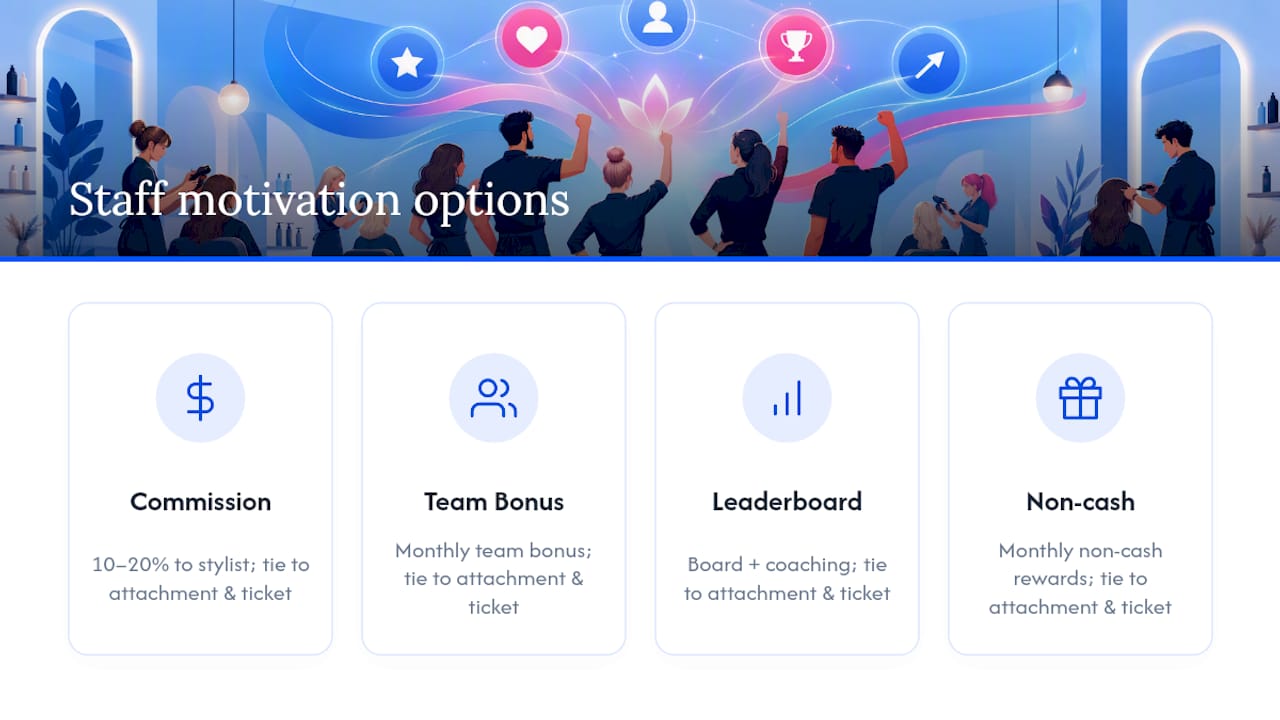
A public leaderboard works for some teams and backfires on others. Confident sellers love the visibility; newer stylists sometimes go quiet rather than risk showing up at the bottom. If you run a leaderboard, pair it with private coaching for whoever’s struggling, not public comparison alone.
Non-cash incentives matter too. A stylist who consistently hits a strong attachment rate might earn first pick of vacation weeks, a free continuing-education class, or product credit for their own use. The specific reward matters less than the consistency of recognizing it every month, since sporadic praise doesn’t change behavior the way a predictable system does.
Whatever structure you pick, tie it to the same attachment rate and average ticket numbers from your rollout dashboard. Staff will optimize for whatever you measure and reward, so measure the behavior you actually want more of.
What Do Real Salon Upsell Wins Look Like?
The clearest pattern in salons that successfully add revenue through upsells isn’t a dramatic overhaul. It’s narrow, consistent execution.
A salon that adds a $35 bond treatment to every color appointment and gets even a third of clients to accept it is adding meaningful revenue per chair, per week, without booking a single extra hour. That’s the entire logic behind profit-per-minute add-ons: the value comes from selling more within the same appointment slot, not from squeezing in more appointments.
The salons that struggle with upsells almost always share one trait: too many add-ons launched at once, with no script and no tracking. Stylists forget half the menu, clients get pitched inconsistently, and nobody can tell which add-on actually worked. The fix is almost always to shrink the list back down to three or four items and rebuild the habit from there.
The more durable win shows up in rebooking, not just the ticket total. A client who leaves with visibly better hair from a gloss or a calmer scalp from a massage has a concrete reason to come back on schedule instead of drifting to a six-week gap. Retention from a satisfied add-on experience tends to compound in a way a single upsold ticket never will.
Where Do Upselling Ethics Come Into Play?
Every upsell tactic in this guide works because it’s honest. That’s not a nice-to-have, it’s the entire reason clients tolerate being sold to in the first place.
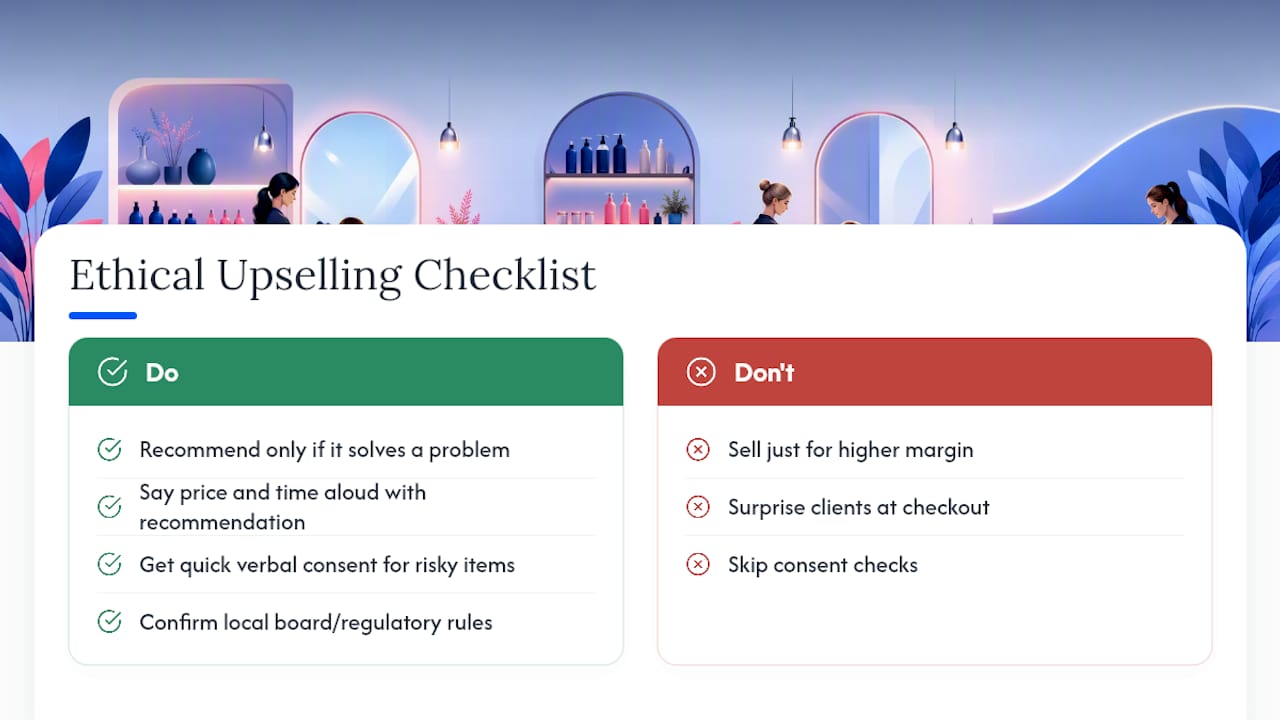
The line is simple: recommend something because it solves a problem you actually noticed, not because it’s the highest-margin item on your list. A client with fine, healthy hair doesn’t need a bond treatment, and telling them otherwise erodes trust the moment they realize it. Stylists who oversell eventually train their clients to say no to everything, including the recommendations that would genuinely help.
Transparency on price and time is non-negotiable. A client should never be surprised by the total at checkout because an add-on was mentioned but the cost wasn’t. Say the number out loud in the same sentence as the recommendation, every time.
Consent matters for anything applied to skin, scalp, or hair that carries any risk, however small, like a chemical gloss or a treatment with active ingredients. A quick verbal check, “have you used a toner like this before, any sensitivity,” takes ten seconds and protects both the client and the salon. Depending on your state or region, some services and product claims are also subject to cosmetology board rules or advertising regulations, so it’s worth confirming your state board’s specific requirements rather than assuming a script that works elsewhere is automatically compliant everywhere.
The salons that build real retention around upsells treat the add-on menu as a way to serve clients better, and the revenue follows as a result, not the other way around.
Owner Perspective: Revenue With Integrity
The upsells that last are the ones a client would ask for anyway if they knew the option existed. Chasing a bigger ticket at the expense of trust always costs more than it earns, because a client who feels sold to stops booking altogether. Retention from a handful of well-placed add-ons beats the cost of constantly hunting for new clients to replace the ones who left.
The mechanics matter less than the discipline behind them. Whether you’re running paper booking sheets or a branded app that surfaces add-ons automatically, the goal is the same: fewer awkward moments, more honest recommendations, and a client who leaves better off than when they walked in.
— Service
How Can a Branded Booking Platform Reduce Upsell Friction?
The salons that scale add-ons well aren’t necessarily the ones with the best scripts. They’re the ones where the booking system does part of the selling before the stylist opens their mouth.
Getexclusively gives salon owners and independent providers a branded booking system where add-on checkboxes, provider-level pricing, and confirmation message templates all live under your own name, not a shared marketplace app competing for the client’s attention.
That control matters because every add-on you set up, from a $35 bond treatment to a $15 scalp massage, shows up exactly the way you priced it, with your own confirmation messaging reminding clients to ask about it before they even arrive. A branded mobile app extends that further with push nudges tied to service history, so a client who skipped the gloss last visit sees it surfaced again next time, automatically.
If you’re ready to stop relying on memory and front-desk timing to sell your add-on menu, take a look at Exclusively’s appointment software and see how the booking flow can carry more of that weight for you.
Sources
- 50 High-Margin Salon Upsells (Guide 57) — The Salon Business
- 4 express salon add-on services that boost revenue — Modern Salon
- Salon add-on services that boost revenue — Lutily Blog
- Salon upselling: Add $300/week with add-on services — HairSalonPro