
6 Salon Website Styles That Convert: Branding, WCAG, LocalBusiness
6 Salon Website Styles That Convert: Branding, WCAG, LocalBusiness

A salon website that looks like your space and books without friction attracts higher-value clients and works as a round-the-clock booking engine. Getting there starts with two decisions: define who your ideal client actually is, and make booking the one obvious action on every page, especially on mobile.
TL;DR:
- Using a consistent, brand-appropriate color palette and fonts on your site and emails ensures your branding aligns with your salon’s pricing and personality.
- Showcasing real space and stylist photos builds trust, while service names and call-to-actions should match your salon’s voice to reinforce authenticity.
- Streamlining the booking process by keeping it on your own domain, minimizing steps, and autofilling details can significantly boost conversion rates.
- Proper structured data and matching local information improve your visibility in local search results and help attract relevant clients.
- Maintaining brand voice across all content and reviews enhances recognition, credibility, and client loyalty.
Table of Contents
- Salon website examples worth stealing ideas from
- The core branding elements your site has to get right
- The technical checklist that makes branding convert
- Keeping your brand voice consistent from booking to aftercare
- Showing personality through your website’s content
- Using testimonials and reviews to reinforce your brand
- Layout and navigation that reflect what you actually value
- SEO considerations built around your brand, not against it
- Why ownership of your brand matters more than the site alone
- How Exclusively gives you the branded platform to match
- Sources
- FAQ
Salon website examples worth stealing ideas from
Six styles cover most of what salons need, and each teaches a different lesson.
- Luxury spa style: full-bleed photography of the space, muted neutral palette, and a single “Reserve Your Visit” button that opens a calendar rather than a form. This attracts clients willing to pay premium prices for privacy and polish.
- Modern editorial style: bold typography, asymmetric grids, and before-and-after galleries placed above the fold. It signals a trend-forward, younger clientele who want to see technical skill fast.
- Minimalist style: white space, one accent color, and a service list with plain language instead of jargon. This works for clients who want clarity and speed over spectacle.
- Community-led style: team portraits on the homepage, staff bios linked to booking, and language that centers “your stylist” rather than “our salon.” This builds loyalty and repeat bookings.
- Instagram-first style: a live feed embedded near the booking button, so recent work does the selling. It suits salons whose growth already comes from social discovery.
- Boutique style: warm, textured photography of the physical space paired with a short founder story. This attracts clients who value a personal, independent feel over a chain experience.
Photography choices matter as much as layout. Space shots set expectations before a client ever walks in, before-and-afters prove skill, and stylist portraits build the personal trust that keeps people rebooking with the same person.
The core branding elements your site has to get right
Your palette and typography should match your pricing, not just your taste. A luxury salon leans on serif or refined sans-serif type and a restrained neutral palette; an approachable, walk-in-friendly salon can use brighter colors and rounder type without looking cheap. Photography should favor real clients and real space over stock images, which flatten trust the moment a visitor notices the model doesn’t work there.
Tone matters in the small moments: booking buttons, service names, and confirmation emails all carry your voice. “Reserve Your Chair” reads differently than “Book Now,” and both should match how your staff actually talk to clients.
- Choose a palette and two fonts that reflect your positioning, then use them everywhere, including email footers.
- Shoot your own space, team, and work rather than relying on stock photography.
- Write service names and CTAs in your salon’s actual voice, then test them on staff before publishing.
- Structure your service menu by outcome, not by product, and show a starting price or range so clients self-select before booking.
- Build a one-page brand kit (colors, fonts, tone examples, approved photos) and hand it to anyone touching the site.
Pro Tip: Ask three current clients to describe your salon in one sentence. If the words don’t match your site’s tone, your branding and your reputation have drifted apart.
The technical checklist that makes branding convert
Good branding fails when the booking flow gets in the way. Keep booking on your own domain or deeply integrated into it, minimize the number of steps to confirm an appointment, and autofill returning-client details wherever the platform allows.
Structured data is the quiet workhorse behind local visibility. Adding LocalBusiness structured data that links your site to your Google Business Profile helps search engines connect the two, and proximity, relevance, and prominence remain the primary local ranking factors. At minimum, include your business name, address, phone number, hours, and social profile links (sameAs) in the JSON-LD, and make sure that information matches your footer and citations exactly, down to one consistent phone number format.
Accessibility is not optional polish. The W3C’s WCAG 2.2 guidelines require a text contrast ratio of at least 4.5:1 for normal text and at least 3:1 for non-text elements like buttons and icons, so your booking button needs to be readable, not just pretty.
- Compress hero images and galleries so mobile pages load fast, since slow pages lose bookings before they load.
- Use a single, tappable booking button that stays visible as visitors scroll on mobile.
- Test your contrast ratios on the actual booking button color, not just body text.
- Keep your Core Web Vitals in check by limiting animations and auto-playing video on mobile.
Complete, accurate Google Business Profile details, paired with matching site structured data, are among the more reliable levers for local search visibility. Getting NAP consistency right across your footer, GBP, and directory listings costs nothing but attention.
Structured data also opens the door to richer search results beyond LocalBusiness. Reviewing which schema types apply to service businesses can help you decide whether Service, Person, or Review markup is worth adding alongside your core listing.
Keeping your brand voice consistent from booking to aftercare
Your header CTA and any sticky mobile booking bar should use the same verb every time. A luxury salon might say “Reserve,” a family-friendly shop might say “Book Now,” but switching between the two across pages confuses visitors about what kind of experience they’re choosing.
Service pages sell hardest when they open with a benefit line, walk through the process in two or three sentences, and end with a starting price or range so clients arrive with the right expectations.
- Write confirmation emails and text reminders in the same voice as your website, not a generic booking-system default.
- Use reminders to include practical instructions, like parking or what to bring, alongside a soft upsell such as an add-on service.
- Present memberships and packages with the same photography and tone as your core service pages, not as a separate discount page.
Pro Tip: If your booking confirmation reads like it came from a different company than your homepage, clients notice, and it undercuts the premium feel you built on the way in.
Showing personality through your website’s content
Brand personality lives in word choice more than in any single design element. A salon built around calm, restorative service should write short, unhurried sentences and avoid urgency language like “limited spots.” A high-energy, trend-driven salon can use punchier copy and lean into current style language its clients already use.
Your About page carries more weight than most salons give it. Instead of a generic history, describe what you believe about hair or skin care and how that shows up in how you work, since specificity reads as authenticity in a way that a polished but vague paragraph never does.
Service descriptions are another place personality hides in plain sight. Naming a treatment “The Reset” or “Signature Color” instead of a generic industry term gives clients something to remember and repeat when they refer friends.
Even your FAQ page can carry voice. Answering “What should I bring to my first visit?” in your own words, rather than a copy-pasted template answer, reinforces that a real person runs the business behind the booking button.

Using testimonials and reviews to reinforce your brand
Reviews work best when they’re placed near the decision they’re meant to support: a testimonial about color correction belongs on the color service page, not buried in a general reviews carousel.
Choose quotes that sound like your actual clients rather than generic praise. A specific line about a stylist listening carefully or nailing a hard-to-match shade does more work than “Great salon, highly recommend.”
Star ratings pulled from your Google Business Profile add a layer of external proof that a testimonials page alone can’t provide, since visitors trust third-party platforms more than a brand’s own curated quotes. Displaying both together, curated quotes for tone and aggregated ratings for credibility, covers both bases.
Keep review requests tied to your brand voice too. A follow-up text asking for a review should read like it came from the same salon as the website, not like an automated system chasing stars.
Layout and navigation that reflect what you actually value
Navigation order tells clients what you prioritize before they read a word of copy. A menu that leads with “Book Now,” then services, then team, then location, signals a conversion-first salon. One that leads with “Our Story” and “Philosophy” signals a salon selling experience first.
Keep the main navigation short, ideally five or six items, since a cluttered menu makes clients hunt for the one thing they came to do: book. Service pages should follow a predictable structure, benefit, process, price, booking button, so returning visitors always know where to find what they need.
Footer content matters more than most salons realize. It’s where your NAP information, hours, and social links live, and it’s the section search engines and clients both check when they want to confirm you’re real and open. Keep it complete and consistent with your Google Business Profile every time you update either one.
SEO considerations built around your brand, not against it
Salon SEO works best when your brand language and your search language overlap instead of competing. If clients search “balayage near me” but your site only says “dimensional color,” you’re leaving a ranking opportunity on the table by using different words for the same service.
Building your site as an authority hub, with dedicated pages for each core service plus an honest FAQ section, supports both search visibility and conversion at the same time, since the same clear service pages that rank well also answer the questions that make a client comfortable booking.
Local relevance depends heavily on consistency: your service area, neighborhood names, and business name should appear the same way across your site, your Google Business Profile, and any directory listings. Location-specific service pages, rather than one generic “our services” page, give search engines more specific signals to match against local searches.
Keep the branding intact in the process. Optimizing for search should never mean stripping out the tone and imagery that make your site recognizably yours, since a page that ranks but doesn’t convert isn’t actually solving the problem.

Why ownership of your brand matters more than the site alone
A branded platform you own compounds in value over time, unlike a profile rented on someone else’s marketplace domain, because every review, backlink, and piece of content builds equity that stays with your business rather than the platform hosting it.
Owning your site and booking system on your own domain also protects your SEO equity and keeps full control of your brand experience in your hands, not a third party’s.
— Service
How Exclusively gives you the branded platform to match
Everything covered here, visual identity, mobile booking, local search setup, and consistent voice, takes real ownership of your website to pull off properly. Exclusively builds that ownership into the platform itself: a fully branded website, integrated booking, and a branded mobile app under your own name, with provider-level control over pricing and availability instead of a generic shared profile.
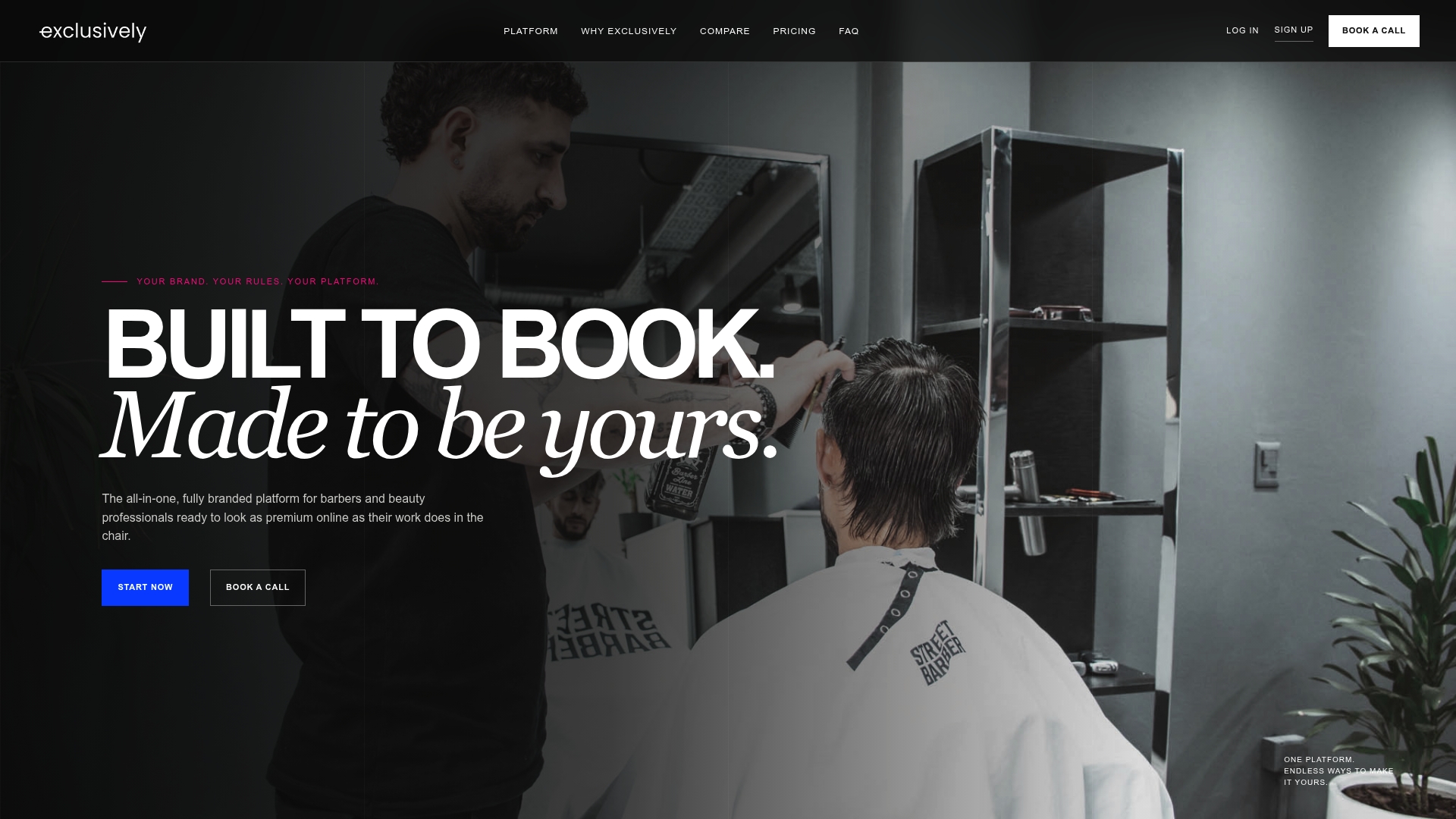
- Business Website: a branded site built to reflect your salon’s identity.
- Website + Booking: adds integrated, mobile-first booking.
- Website + Booking + Apps: adds native iOS and Android apps.
This fits salons and barbershops that want to stop renting their online presence and start owning it, brand, booking, and app, in one place. Check plan details on the pricing page or book a call to talk through what fits your business.
Sources
FAQ
Does salon booking need to work well on mobile?
Yes. Most clients discover and book salon services on their phones, so a slow or clunky mobile booking flow costs you appointments before a client ever reaches your calendar. Keep the flow short, autofill returning-client details, and test the actual buttons on a phone, not just a desktop preview.
Should I show prices on my salon website?
Showing a starting price or range on each service page helps clients self-select before they book, which reduces awkward conversations and no-shows. Exact final pricing can still depend on consultation, but hiding price entirely tends to filter out serious bookers rather than protect your rates.
What kind of photos should a salon website use?
Real photos of your space, your team, and your actual work outperform stock imagery because clients can tell the difference and trust drops the moment they notice it. Space shots set expectations, before-and-afters prove skill, and stylist portraits build the personal connection that drives repeat bookings.
How important is website accessibility for a salon?
It matters both for usability and for reaching every potential client. WCAG 2.2 sets a minimum text contrast ratio of 4.5:1 and a 3:1 ratio for buttons and icons, so checking your brand colors against those thresholds before launch avoids a site that looks good but is hard to actually use.
How does branding affect the type of client I attract?
Your color palette, photography, and word choice signal price point and personality before a visitor reads a single service description. A polished, muted, editorial site attracts clients expecting premium pricing, while a bright, casual, community-focused site attracts clients looking for approachable, walk-in-friendly service.